

The Threshold [pt. VIII]
The Container Problem

Author’s Note
The last installment established the mechanism: the threshold state shifts hemispheric dominance, the aperture opens, and the phenomenon (which has been transmitting continuously the whole time) is finally received.
This one asks what happens when the aperture opens and there’s no container to hold it. Every tradition that ever developed a genuine contact practice understood that the threshold crossing needed a frame, not to limit what came through, but to make it survivable. We’ve spent three centuries dismantling those frames. And then we’ve acted bewildered at the psychological wreckage.
This installment ends on a darker question that’s been waiting since Part I: whether the phenomenon merely finds the conditions of reception, or whether it has a hand in creating them. I hold it as a question, not a claim. But it’s one I can’t put down.
John Mack and the Initiated Researcher
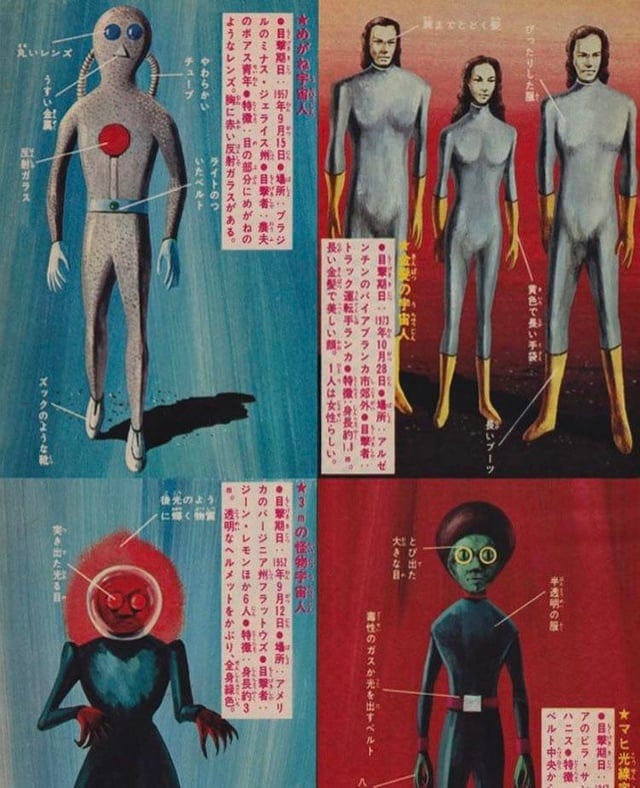
Unknown Artist, Alien Illustrations from a Japanese Children’s Magazine, 1975.
There’s a figure in the contact research tradition who deserves more careful theoretical attention than his later reputation has allowed.
John Mack was a Harvard psychiatrist, a Pulitzer Prize–winning biographer, and one of the most rigorously trained clinical observers in the field before he ran into the abduction phenomenon in the early 1990s. He came to it as a skeptic doing a clinical favor: he’d give experiencers a safe room to talk through their accounts and figure out whether they needed psychiatric help.
What he found was that the experiencers, on systematic clinical evaluation, didn’t meet diagnostic criteria for psychosis, dissociation, or fantasy-proneness at rates any higher than the general population. They weren’t mentally ill. Many of them were, if anything, more psychologically integrated and more reality-tested than average. And their accounts had the kind of structural consistency that, in any other clinical setting, would be called convergent testimony.
What happened to Mack over the course of that research is the phenomenon he ended up documenting better than anyone: ontological shock. The systematic destabilization of a trained, defended, epistemologically sophisticated mind by evidence it can’t fit into its existing framework.
He wrote about this experience later with a candor that’s rare in academic literature. The encounter with the contact evidence didn’t just challenge his beliefs. It disrupted his relationship to the entire framework within which belief and doubt had been operating in the first place.
It was a liminal experience in van Gennep’s precise sense: it stripped him of the identity he’d been occupying (the skeptical Harvard psychiatrist) and dropped him into a state of genuine not-knowing, out of which a new orientation slowly emerged. In interviews near the end of his life, he described it as the best thing that had ever happened to him intellectually. The most alive he’d ever been. The most genuinely uncertain, and therefore the most genuinely open.
This matters for the theoretical argument in a way that hasn’t been developed. If the initiatory structure can be transmitted not only through direct encounter but through sustained, serious engagement with the evidence of encounter, then the contact phenomenon has a propagation mechanism the object-hypothesis can’t account for: genuine intellectual contact with the dual signature may itself be a threshold event. Not a substitute for direct contact, but an access condition in its own right; one the left hemisphere’s processing architecture is specifically built to resist, and one that demands the same openness, the same willingness to sit inside real uncertainty, that the liminal state demands.
(If you’ve felt some version of that vertigo reading this series, you may be closer to the subject matter than you bargained for. That’s not a sales pitch. It’s a warning, offered fondly...)
Mack was initiated by his research. He was not the same person at the end of his life that he was when he started. And the synthesis his late work was building toward (the account of the contact phenomenon that his years of clinical documentation and his own ontological shock had been moving him toward) was never finished. He was killed by a drunk driver in London in 2004.
This series is trying to move in the direction he was traveling. Whether it gets anywhere close is a question I hold with the same openness he learned, near the end, to bring to every question the phenomenon poses.
The Container Problem: When the Aperture Has No Frame
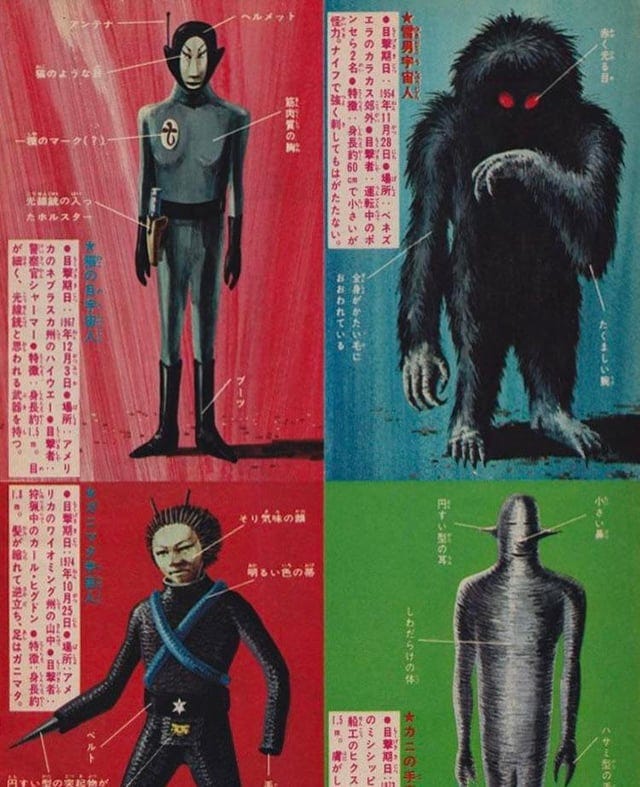
Unknown Artist, Alien Illustrations from a Japanese Children’s Magazine, 1975.
Every initiatory tradition in the historical record developed alongside a body of hard-won knowledge about what happens when the threshold crossing goes wrong. Not the failure of the candidate who refuses the passage, the other failure. The catastrophic one, where the passage succeeds in dissolving the bounded self and then doesn’t put it back together…
Van Gennep’s three-phase structure isn’t only descriptive. It’s prescriptive: it tells you what makes the crossing survivable. The separation has to be bounded (the initiate has to know they’ll return). The liminal phase has to be held by a structure that contains the dissolved self while it’s being remade. And the incorporation has to be real (the new identity has to be recognized and welcomed by the community the initiate comes back to).
Knock out any one of the three phases and the liminal state doesn’t resolve. The dissolution just... continues. The wound stays open.
Victor Turner’s communitas-gone-wrong is what that looks like from the inside: the radical dissolution of self without the reconstruction, the porous boundary without the return to bounded identity, and the openness without the integration that makes openness sustainable. Clinically, it shows up as depersonalization, derealization, the inability to re-establish an ordinary sense of self. And it produces something else that doesn’t have a good clinical name: the state of being permanently at the threshold, permanently unable to close the aperture the encounter forced open.
The contact literature is full of this. The experiencers who describe years of involuntary threshold experience with no framework and no support. Encounters that kept coming whether they were wanted or not. An inability to return fully to the ordinary world, not because the ordinary world wasn’t enough, but because the aperture, once forced open without the container that would have made it survivable, simply would not close.
This isn’t evidence against the initiatory thesis. It’s the thesis’s most important corollary: the same mechanism that makes the threshold productive can, without a container, make it destructive. The shamanic traditions that grew up alongside the contact phenomenon understood this perfectly. They built elder structures, community recognition, and integration protocols precisely because they’d watched what the uncontained threshold did to people, and had developed the technology to make it survivable.
What contemporary Western culture offers UAP experiencers is the complete absence of that container. The encounter happens. The aperture is forced open. And then the experiencer is returned to a culture with no framework for what happened, no elders to receive them, no protocol to complete the passage, and frequently a psychiatric establishment standing by to pathologize the liminal state rather than honor and complete it.
Van Gennep’s third phase, incorporation, is exactly the phase Western modernity has dismantled. We kept the threshold. We lost the ceremony of return.
What this means in practice, and what any serious account of the contact phenomenon has to eventually face, is that the theoretical framework this series is building can’t be separated from a practical framework for how experiencers get supported in completing what the encounter began. The mechanism and the ethics of response aren’t two different questions. They’re the same question. And the answer means recovering something from the initiatory traditions that we threw out when we decided the only real things were the things the left hemisphere’s instruments could measure.
That practical framework is what I've been trying to build, and it has a name: ontological health. I have an essay on it coming out next week, so I won't develop it here. But the short version is that it treats the aftermath of contact as an integration problem rather than a psychiatric one, and asks what a container adequate to these experiences would actually look like now, given that the old ones are gone.
The wound is real. The aperture is real. The container that would make them survivable is recoverable. That’s not a therapeutic observation in the narrow clinical sense. It’s a civilizational one.
The First Opening
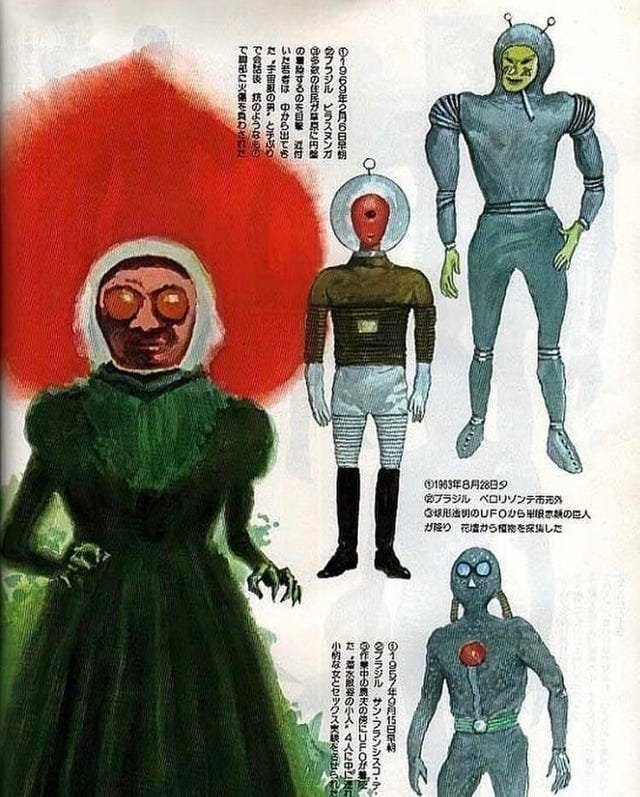
Unknown Artist, Alien Illustrations from a Japanese Children’s Magazine, 1975.
There’s a pattern in the contact literature that the neurological framework lights up in a way no existing account has developed: the disproportionate frequency of first contact in childhood.
Across Mack’s casework, across the spontaneous contact literature, and across the accounts experiencers give when asked to trace the full arc of their experience, a striking proportion report their first encounter before the age of ten. The pattern is consistent enough to count as a finding. And it has a precise neurological explanation that, as far as I can tell, nobody has connected to the McGilchrist framework.
Children run on significantly less left-hemisphere dominance than adults. The categorical machinery that normally processes anomalous input as error (the filing system that classifies the transmission as noise) is still under construction. The boundary between self and world, which the left hemisphere works around the clock to maintain in the adult nervous system, is genuinely more porous in early childhood.
If the aperture opens through the disruption of ordinary left-hemisphere dominance, and if contact requires the kind of hemispheric shift that liminal states induce, then children are sitting closer to the required receptive state as a baseline condition of normal development. The threshold is lower. The signal doesn’t have to work as hard to get through.
And that has an implication that goes well past explaining first contact. If the phenomenon makes initial contact during the developmental window when the receiver is most available, and if the contact event partially and permanently disrupts the left hemisphere’s later development of its categorical grip, then the adult experiencer who reports ongoing contact across decades may not be having a series of separate encounters at all. They may be experiencing the continued reception of a transmission that was opened in childhood, through an aperture the first encounter left partially and permanently ajar.
This reframes the lifelong-contact pattern entirely. The adult encounters aren’t new initiations. They’re the continuation of one initiation that began when the receiver was neurologically most available, and that has been unfolding, crystallizing, and deepening ever since. The childhood encounter opened the aperture. Everything after has been the transmission arriving through it.
Van Gennep’s incorporation phase (the third stage, where the threshold state is honored and integrated into the experiencer’s ongoing life) may run on a timescale only the full arc of a human life can complete. The initiation isn’t an event. It’s a developmental trajectory whose first threshold was crossed before the experiencer had the cognitive equipment to understand what was happening.
Places That Remember
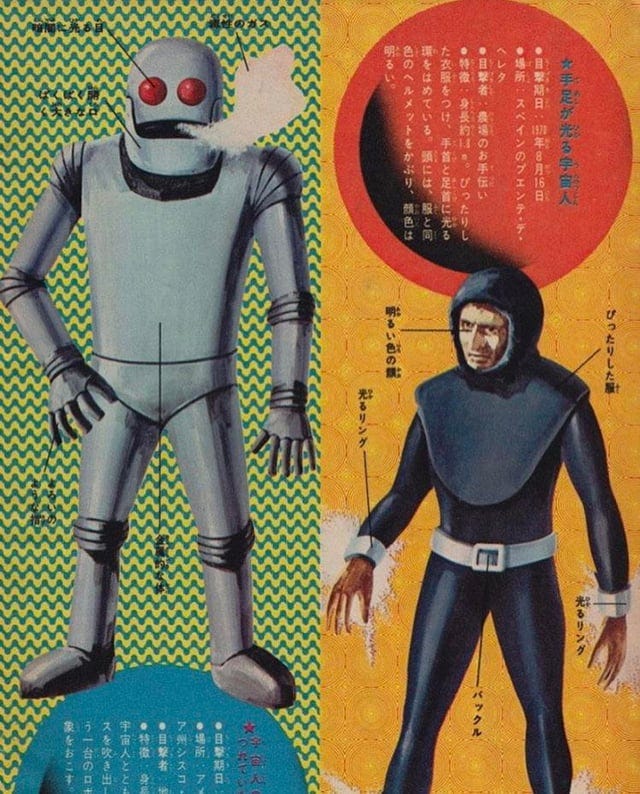
Unknown Artist, Alien Illustrations from a Japanese Children’s Magazine, 1975.
Keel’s “window areas” have always been the most practically verifiable and the most theoretically underexplored part of his work. The observation is plainly empirical: certain geographic locations generate encounter after encounter, decade after decade, across witnesses with no connection to each other. Point Pleasant. The Hessdalen Valley. The region around Skinwalker Ranch. The areas Keel documented in The Eighth Tower (1975) as sites of persistent, concentrated strangeness.
Keel’s own interpretation was that the phenomenon “lives” in these places. Not that it visits them, but that it’s native to them, inhabiting portions of the electromagnetic spectrum beyond ordinary human perception, permanently present in spots where the conditions for being perceived happen to be persistently met.
The liminal reading takes this further and connects it to something every culture with a long enough memory has independently noticed: certain places are thin. The megalithic sites of Britain and Ireland. The oracle sites of the ancient Mediterranean. The sacred mountains and ceremonial grounds of the Indigenous Americas. The places of persistent pilgrimage across every tradition that has one.
These aren’t merely places where humans decided to hold rituals. They’re places where the threshold is structurally, persistently, geographically closer to the surface. Where the left hemisphere’s categorical machinery is, for reasons that may be geophysical or electromagnetic or something we don’t yet have a framework for, chronically less stable than elsewhere. Where the right hemisphere’s perception is more easily reached, where the aperture opens more easily, and where the transmission is more easily received.
The landscape itself can be at the threshold. The setting can do some of the work of the neurological shift.
This maps cleanly onto the UAP window-area literature. The encounters aren’t random. They cluster in locations that, by every tradition that’s ever developed a vocabulary for such things, have always been recognized as thin places: spots where the boundary between ordinary reality and whatever sits adjacent to it stays more permeable than it does anywhere else.
The phenomenon doesn’t pick these locations arbitrarily. They’re the places where the aperture is already partly open, and where the receiver is already partly shifted toward the hemisphere capable of reception. The transmission finds the places where it’s most likely to land.
