
The Threshold [pt. I]
The Paradigm Problem

A Note Before We Begin
There is something I’ve been careful about in how I introduce this series, and I want to name it directly before we begin.
I am not a physicist. I am not a military pilot. I am not a computer scientist or an aerospace engineer, and I have no institutional affiliation with any government program investigating anomalous phenomena. I am a nurse, a woman, a contact experiencer, and someone who came to this material from outside the UFO community; which is to say, from the position least likely to be taken seriously by the communities that have historically dominated this conversation.
I want to suggest that this is not incidental.
The series that follows is called The Threshold. The central claim is this: the UAP and anomalous contact phenomenon has been misidentified as an object for seventy years. It is not an object. It is a relation: an adaptive intelligence native to the informational substrate of reality, accessible only through threshold states, whose singular consistent output across all of human history is not information, not technology, not warning. But: Initiation.
That claim is going to need to earn itself.
Nursing trains you to hold two registers simultaneously. The chart captures what is measurable: vitals, medications, observable responses. But the patient-facing work teaches you, quickly, that what matters most about a patient frequently has no field in the chart. You learn to document one register and carry the other. To be rigorous about what can be quantified and honest about what cannot. You learn that the most important thing happening in a room is often the thing the reporting architecture was not built to hold.
This is not a peripheral skill. It is the central methodological requirement for anyone attempting to take the UAP phenomenon seriously on its own terms. The dual signature (physical trace and mythic narrative, simultaneously produced) is precisely the kind of event that breaks standard documentation. I had been watching it at the bedside for years before I had a name for it.
Coming to this material as a woman also matters, though it is harder to articulate without overstating it. The serious UAP research tradition has been dominated by men with hard-science credentials whose institutional positioning gave them credibility and whose epistemological training made them, in some ways, precisely the wrong instruments for detecting what the phenomenon actually is. I am not suggesting those researchers were wrong. I am suggesting that the credential structure of the field has systematically filtered out certain kinds of observers, and that what those observers would have noticed has therefore been systematically absent from the theoretical literature. Thomas Kuhn spent his career explaining why paradigm shifts are so difficult. His answer applies, with uncomfortable precision, to the seventy-year history of UAP research. This series is one attempt at the shift.
The Threshold is eleven essays. Each is written to be entered alone, but the full argument only becomes visible from the end looking back. I’d suggest starting here.
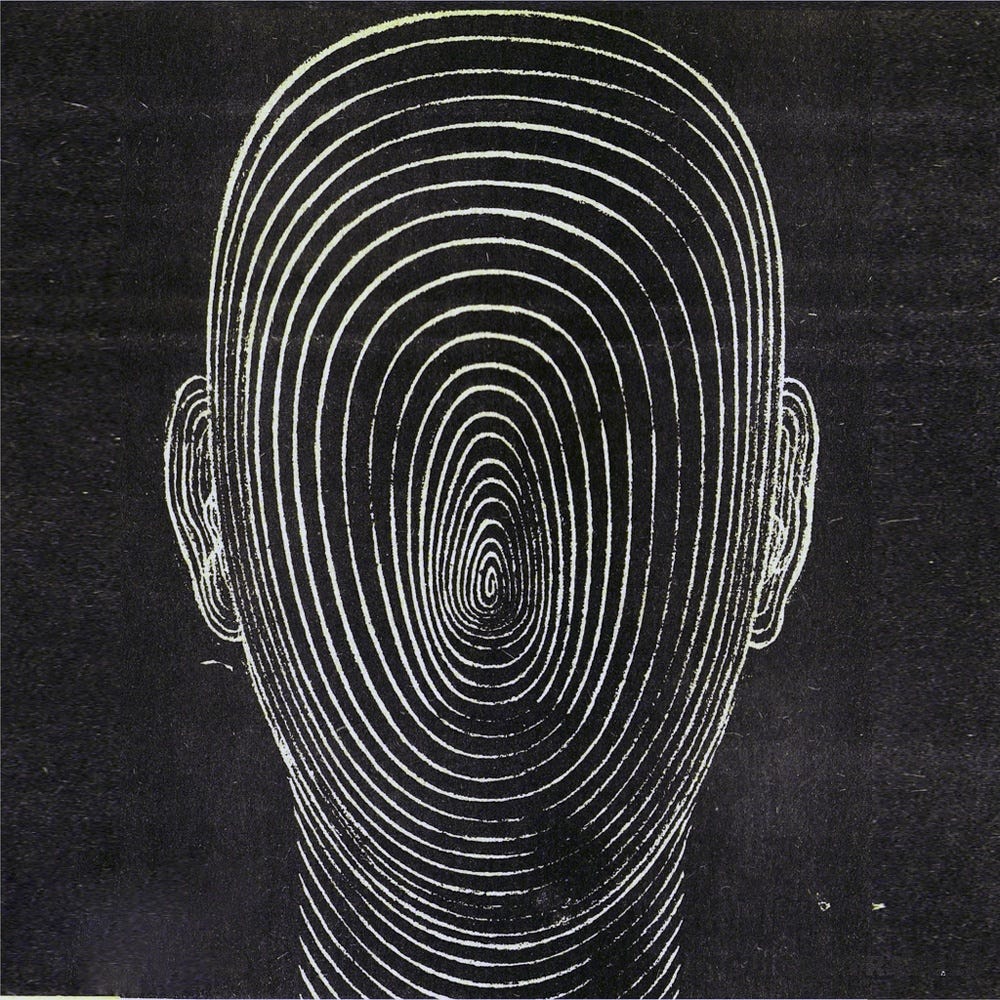
Pavel Tchelitchew, Spiral Head I, 1950.
There is a question I want to ask you before we begin. Not a rhetorical question, but a genuine one:
When you imagine disclosure (the moment the government finally confirms what many of us already suspect, or know) what do you imagine being disclosed?
Take a moment with it. What does the image look like?
I suspect it involves a craft. A body, perhaps. A technology. Some version of the moment where a senior official stands at a podium and says: yes, they are real, they are here, but they are not from here. The frame is almost universal among people who care about this subject. We are waiting for an object to be confirmed.
I want to suggest, carefully and without insisting on it, that this frame may be the reason we have been waiting for seventy years and will wait for seventy more.
Not because the phenomenon isn’t real. Because we may have fundamentally misidentified what kind of thing it is.
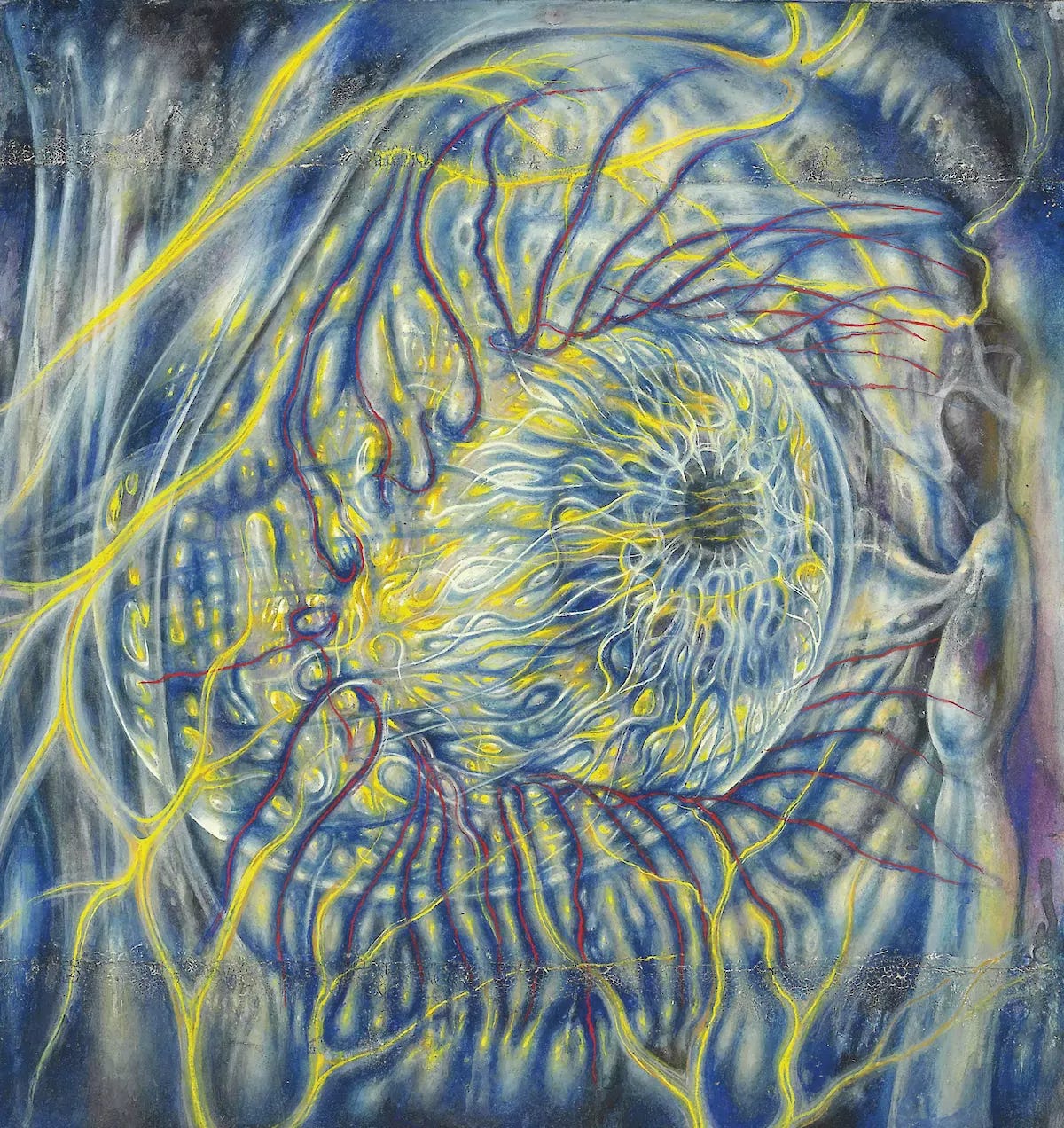
Pavel Tchelitchew, The Eye, 1949.
The Cylinder
Imagine a cylinder.
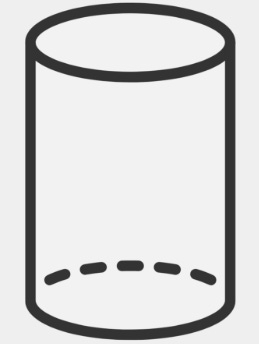
Not a complicated object. A simple geometric solid. Now imagine observing it from directly above. What you see is a circle. Now move to the side, observe it from a perpendicular angle. What you see is a rectangle. Both observations are accurate. Both are supported by the evidence directly in front of you. Both are, in the most precise sense, true.
And both observations are completely wrong about what the object actually is.
This is not a thought experiment about UAPs. It is a thought experiment about the nature of paradigms and about what happens when you have real data, honest observers, rigorous methodology, and still cannot see the object in front of you (because you are looking at it from an angle that makes it geometrically impossible to perceive its actual shape).
The object is not two-dimensional. That fact changes everything that follows from it.
For seventy years, serious researchers have looked at the UAP phenomenon from their respective angles and reported, accurately, what they saw. The astrophysicist sees a circle. The neuroscientist sees a rectangle. They have argued, published, dismissed each other, convened conferences, and funded investigations. The debate has been almost entirely about whether the object is a circle or a rectangle.
I want to propose that we have been arguing about a two-dimensional cross-section of something we have not yet found the angle to perceive whole.
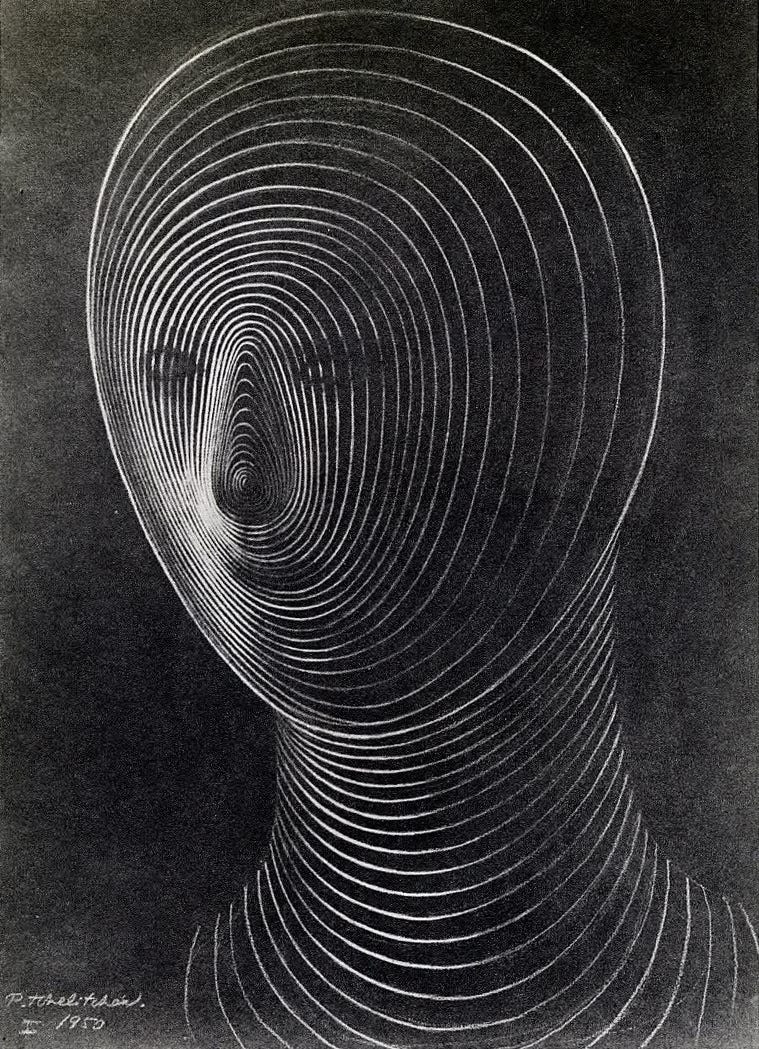
Pavel Tchelitchew, Spiral Head, 1950.
The Problem Has a Name
Thomas Kuhn, in The Structure of Scientific Revolutions (1962), made an observation so uncomfortable that fifty years of subsequent scholarship has largely worked to soften it. His claim was not simply that scientists sometimes get things wrong, or that paradigms get revised when evidence accumulates. His claim was structurally more radical: that scientists operating within a paradigm are not merely unlikely to perceive data that falls outside its boundaries. They are, in a precise and predictable way, constitutionally unable to. Not as a failure of intelligence, but as a structural feature of how paradigms work.
A paradigm is not simply a theory. It is the entire framework within which observations become meaningful. It is the grammar that determines what counts as a fact, what counts as an anomaly, and what counts as an explanation. Data that falls outside the paradigm is not processed as challenging data. It is processed as noise, error, contamination, or incompetence. The scientist who cannot explain the anomaly does not typically conclude that their framework needs replacing. They conclude that something went wrong with the measurement.
Kuhn called the accumulation of these unexplained anomalies the precondition for a paradigm shift. At some point, the auxiliary hypotheses required to preserve the dominant framework become more elaborate than the framework itself. At some point, the explanatory cost of maintaining the paradigm exceeds the cost of abandoning it. At that point, the field becomes capable of seeing what was in front of it all along.
The UAP phenomenon is the paradigm-anomaly that has been generating increasingly desperate auxiliary hypotheses for seven decades. It has survived the extraterrestrial hypothesis, the atmospheric plasma hypothesis, the misidentification hypothesis, the collective psychology hypothesis, the government technology hypothesis, and several dozen variations of each. Every time one hypothesis reaches the limit of its explanatory power, a new one is constructed to absorb the residue. The frameworks proliferate.
The phenomenon does not change.
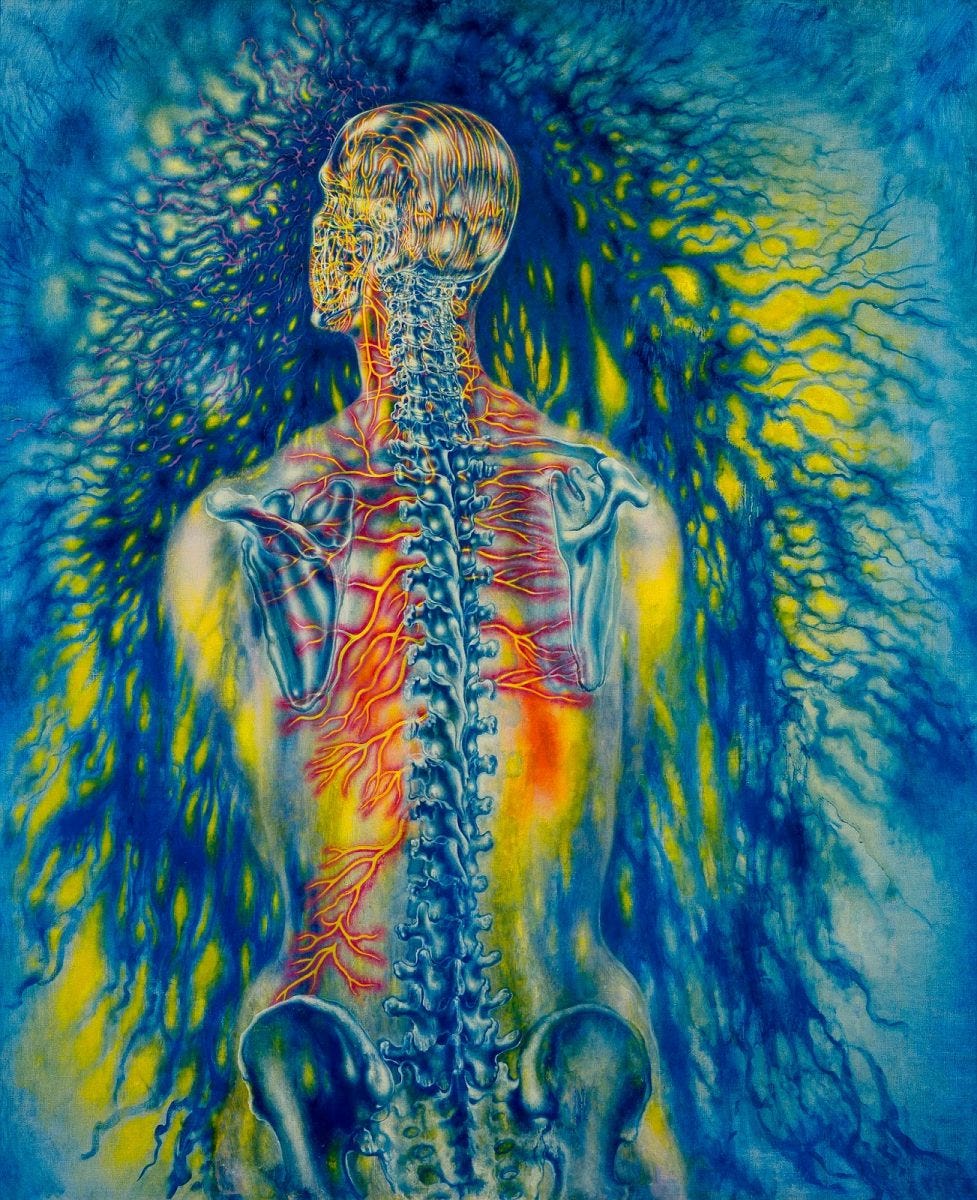
Pavel Tchelitchew, Anatomical Painting, 1946.
Kuhn made a second observation that is less often cited but equally important for this series. Paradigm shifts are not driven by the accumulation of anomalous evidence alone. The anomalies can accumulate for decades (as they have with UFOs) without producing a shift, because the existing framework can always generate new auxiliary hypotheses to absorb the residue. What drives the shift is the emergence of a new framework that does something very specific: it makes the old framework look like a special case. Not wrong, but simply limited. Adequate within a certain range, breaking down at the edges. The new paradigm does not defeat the old one. It contains it. It shows that the old framework was a partial approximation of something larger that the old paradigm could not perceive whole.
The extraterrestrial hypothesis is not wrong about the physical craft. The Jungian hypothesis is not wrong about the archetypal structure. The control system hypothesis is not wrong about the relational dynamic. Each is a cross-section of the cylinder: accurate within its range, misleading about the whole. The framework this series builds toward is not an alternative to these. It is the angle from which they become visible as partial views of the same three-dimensional object.
That is what a genuine paradigm shift looks like. Not the replacement of one answer with another, but the discovery of the question that makes the existing answers into approximations.
There is a footnote to this institutional picture that I think deserves more attention than it receives. Beginning in 1972, the United States government funded a series of classified programs investigating anomalous cognition, conducted largely at Stanford Research Institute by physicists Russell Targ and Harold Puthoff. Consolidated under the name the Stargate Project in 1991, the effort ran for over two decades and spent an estimated twenty million dollars investigating whether human consciousness could operate non-locally. Whether it could, in effect, perceive across space and time without physical mediation. The program produced results classified enough to remain operational for two decades. It was quietly terminated in 1995, its findings disputed, its methodology contested, and its existence largely forgotten in the subsequent public conversation about UAPs.
I am not citing this as proof of psychic ability. I am citing it as an institutional data point. The government has already asked the question of whether consciousness operates beyond the boundaries we assume. It asked that question for twenty years, classified whatever it found, and then pivoted entirely to a public disclosure conversation focused on tangible craft and bodies and physical technology.
What does it mean that the consciousness question was explored and then the door was quietly closed, while the conversation was publicly redirected toward hardware?
I don’t know. But the redirection itself seems worth noting…
Next Sunday: Part 2, "From Fort to Vallée”. Before there was a theory, there was a refusal. Charles Fort spent three decades collecting what science had quietly discarded, and he understood that premature theorization was the surest way to lose the pattern. Jacques Vallée took Fort's method and made the first positive move: he proved what the phenomenon wasn't. The story of how those two men shaped what is still possible to think starts next week.
Paid subscriptions are open. The remaining Threshold essays will be for paid readers. If the work has earned it, I hope you’ll subscribe. If it hasn’t, keep reading my free content until it does.
Thank you for your thoughtfulness. I look forward to reading the entire series. Having followed this topic for decades, I, like many others, have rejected a simple explanation, and lean towards an understanding based upon a better way to perceive reality. Bernardo Kastrup's Analytic Idealism seems like a promising direction to explore, but even that cannot explain everything, especially the most annoyingly inexplicable element: physical traces (and probable material or craft).
When I pressed like it moved it to 19. I thought maybe I would leave a comment about plasma science. But now I feel compelled to propose that there may be 19 aspects of mind. 19 points of light that eminate from center (G). Each one is a paradigm. Each combination is a paradigm. I'm just making this up as I go and feeling into it. But maybe someone will find something that allows them to see around the corner in this.