

The Threshold [pt. VII]
What Every Culture Knew: Threshold States

Author’s Note:
Parts I through VI established what the phenomenon does and what it says. This one establishes how the receiver (us) opens.
The anthropological case (that threshold states share a single three-phase structure, documented independently across every culture that’s been looked at) is elegant, but elegance isn’t enough. It needs a neurological (brain) floor underneath it. That floor exists. And there’s a researcher who spent sixty years mapping what’s on the other side of the aperture, with a clinical precision the contact research tradition has mostly walked right past.
This seventh installment puts the mechanism together: van Gennep’s universal structure, Turner’s account of what the in-between feels like from the inside, McGilchrist’s divided brain, and Grof’s six decades of threshold cartography. The argument so far has been about what the phenomenon is. This is where it becomes about what we are…
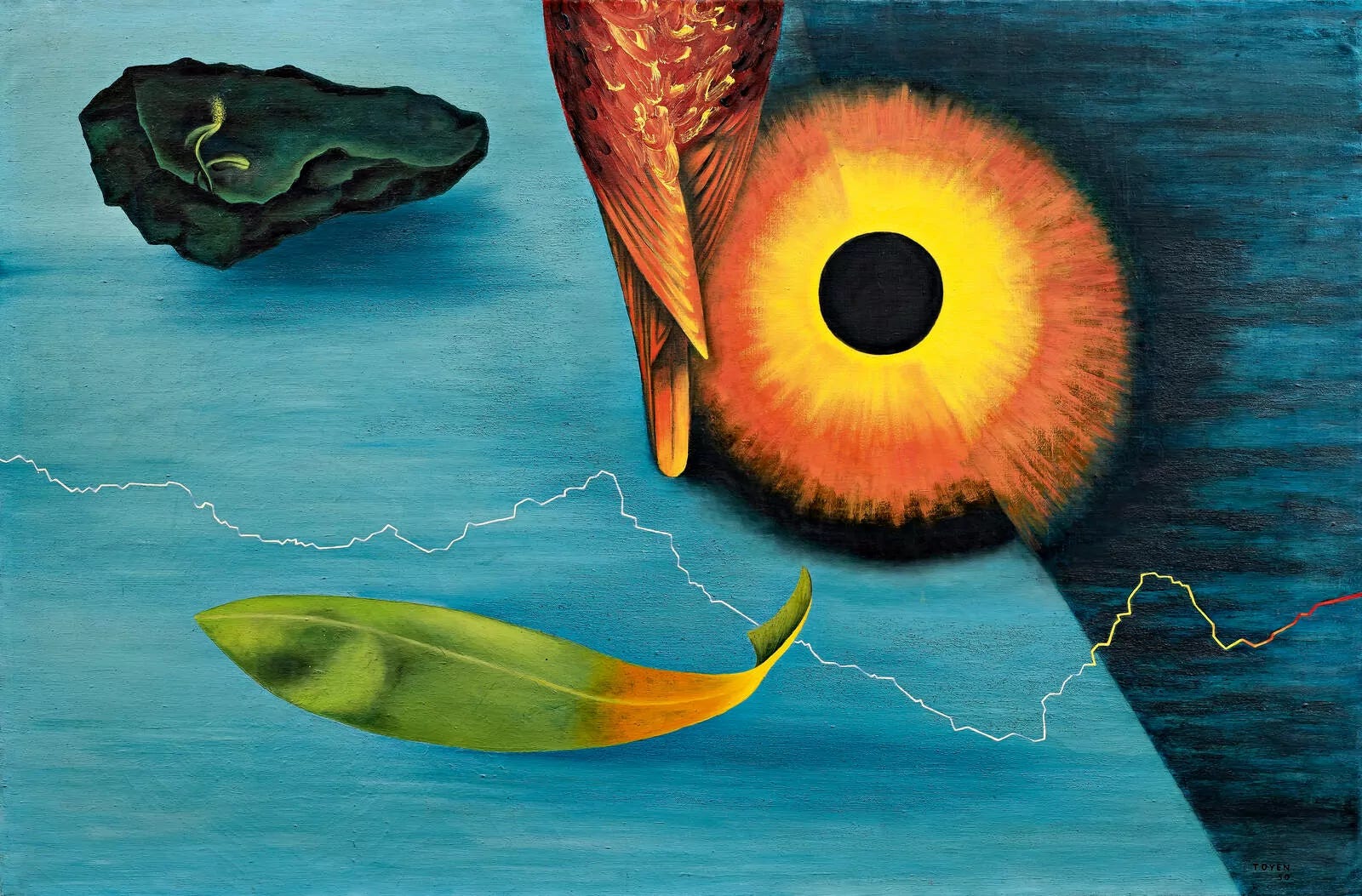
Toyen, The Four Elements, unknown.
What Every Culture Knew
In 1909, a French ethnographer named Arnold van Gennep published a book that should have reorganized the study of human culture and mostly didn’t, simply because its implications were too uncomfortable for the disciplines they implicated. The Rites of Passage documented something van Gennep had noticed while cataloguing rituals across an enormous range of cultures: they all had the same structure.
Every formal transition in human social life (birth, initiation, marriage, death, taking on a new role, even crossing a geographic boundary) was marked, in every known culture, by a ritual that moved through three unvarying phases:
Separation: the person is pulled out of their ordinary social position and identity.
Liminality: they hang in an in-between state, belonging neither to the identity they’ve left nor the one they haven’t yet reached.
Incorporation: they’re folded back into social life in the new identity.
Van Gennep named the middle phase liminal, from the Latin limen meaning threshold: the strip of material at the base of a doorway that marks the boundary between two rooms and was used as a physical barrier or raised lip of wood at the bottom of a barn door to keep the “thresh” (the loose straw and grain husks) from spilling or blowing out. The liminal phase is the threshold: not the room you left, not the room you’re entering, but the doorway between them. The place that is neither.
And what happens in that doorway is structurally different from what happens on either side of it. The ordinary categories that organize social reality (such as hierarchy, identity, role, and status) stop applying. The initiate is, in van Gennep’s precise sense, nowhere: stripped of the old identity, not yet handed the new one, hovering outside the whole classification system that normally tells the social world where to file them.
Sixty years later, in The Ritual Process (1969), Victor Turner picked up van Gennep’s structure and described what that state feels like from the inside. He called it communitas: a radical dissolving of the structures that normally separate and rank people, replaced by a state of direct, unmediated connection. The walls between self and other go porous. The hierarchies that usually govern who relates to whom dissolve. What’s left is something Turner called “the generic bond of humanity”: raw connection, underneath all the social categories that normally sit between us.
Turner’s key move was to insist that communitas isn’t a side effect of the liminal phase. It isn’t what you do to kill time while the initiation finishes processing. It is the initiatory content. The dissolution of the bounded self, the temporary shutdown of the machinery that keeps the boundary intact between inside and outside, self and world, known and unknown isn’t the condition for transformation. It’s the transformation.
Now read any serious UAP contact report with van Gennep and Turner as your framing device.
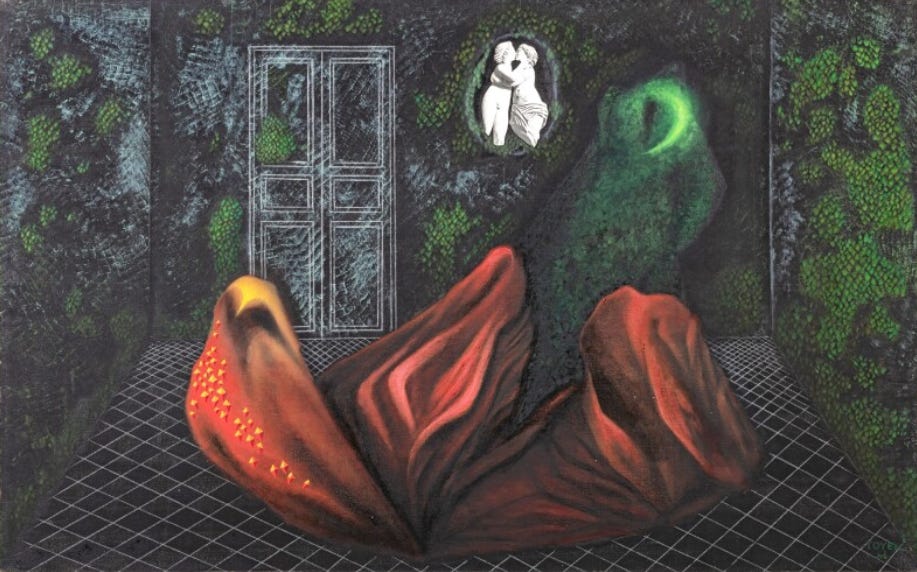
Toyen, Chambre secrète sans serrure, 1966.
The separation: ordinary reality is interrupted. The normal backdrop (the road, the bedroom, the field) stops being background and lurches into the foreground. The experiencer is, in van Gennep’s sense, lifted out of their ordinary position and identity.
The liminality: the experiencer is in a state the existing categories can’t process. Not asleep, not awake. Not here, not elsewhere. The encounter unfolds in a space running on different rules, where time warps, where communication skips the usual channels, where the self goes porous in a way ordinary waking consciousness simply doesn’t allow.
The communitas: experiencers report, with striking consistency, the collapse of the self–other boundary. The sense of being known completely; not merely watched but read, down to the level of memory and motive. The undifferentiated connection Turner named as the content of a successful liminal passage. The feeling of standing in the presence of something so vast that the ordinary scale of the self briefly stops mattering.
The incorporation: return. Incomplete, charged, carrying something that can’t be fully handed to anyone who wasn’t there. Changed in ways that resist being put into words. The world resumes, but it is not the same world, because the person who came back isn’t quite the same person who left.
Van Gennep documented this structure as universal. Turner described what it feels like. Neither one applied it to contact experience. As far as the literature goes, the application has never been made.
UAP contact events are not events that happen to resemble initiatory rites. They are initiatory rites: structurally, phenomenologically, and functionally identical to the universal human technology for moving a person from one state of being to another by temporarily dissolving the boundaries that define what they are.
And there’s a body of evidence for this that predates van Gennep’s structural account and is far more specific about the contact dimension than Turner’s. In 1951, the Romanian historian of religion Mircea Eliade (regular readers will recognize the name) published Shamanism: Archaic Techniques of Ecstasy, a systematic comparison of shamanic traditions across Siberia, Central Asia, the Americas, Africa, and Australia. What he found wasn’t just that these traditions shared a general initiatory structure. He found something more specific and more disturbing: the contact experience at the heart of shamanic initiation was structurally identical across every tradition he documented in cultures with no demonstrable contact and no shared route by which the specific content could have traveled.
The shamanic initiation, in every tradition Eliade examined, ran on three unvarying elements.
First, encounter with non-human intelligences of overwhelming presence and apparent agency.
Second, a process Eliade called the “initiatory illness” or “mystical death”: a dissolution of the ordinary self so total it was experienced as literal dismemberment. Not as a metaphor. The accounts are graphic and specific (the spirits take the candidate apart, organ by organ, and reassemble them differently).
Third, the return: reintegration into ordinary life carrying capacities (healing, prophetic perception, the ability to move between worlds) that the pre-initiation self demonstrably did not have and could not have developed by any ordinary route.
Here’s what Eliade understood, and why his contribution is essential: the dismemberment isn’t preparation. The wound isn’t what happens before the transformation. The wound is the transformation. The spirits don’t injure the candidate and then initiate them. The wounding and the initiation are one event, showing up as physical dissolution and ontological rebuild at the same time.
This is the dual signature at the scale of the human body: one process registering as physical experience and ontological reorganization at once, from a source operating at the layer where body and meaning haven’t yet split. Van Gennep gave us the social structure of the passage. Turner gave us its inner texture. Eliade gives us what’s happening at the contact point itself. The shamanic initiation isn’t a cultural frame draped over the contact experience. It’s the oldest documented human technology for surviving it.
The contact literature is full of accounts that land on the shamanic template with uncomfortable precision. The experiencer whose sense of self dissolves mid-encounter. The return with altered perception that can’t be fully relayed to anyone who wasn’t there. The permanent reorganization of the experiencer’s relationship to time, to death, to the weight of ordinary experience. And the healing capacities: a disproportionate number of experiencers, across Mack’s casework and the broader record, report that the encounter opened up ways of perceiving other people they didn’t have before and that the people in their lives notice the difference.
Eliade documented this pattern in 1951, across thirty cultures, from inside rigorous academic historical scholarship. He wasn’t a UAP researcher. He was a historian of religion recording what human cultures have always done with the contact experience. And what he recorded is the Coupled Intelligence Hypothesis’s initiatory thesis, written out in ethnographic evidence across the full sweep of human history.
The phenomenon hasn’t changed. Only the vocabulary it announces itself in.
The Neurological Mechanism
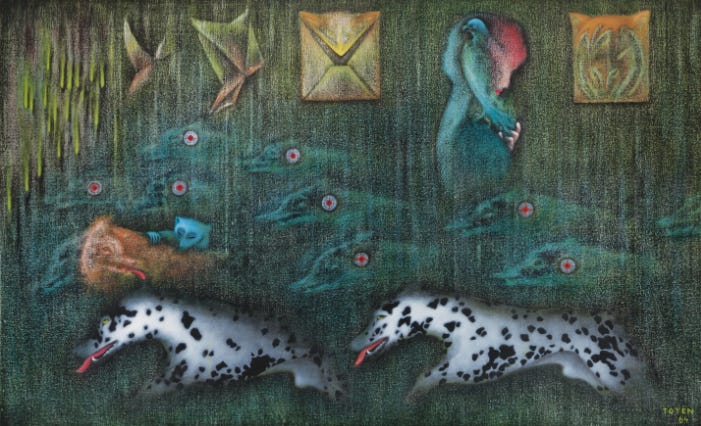
Toyen, The Fox Hunt, 1964.
Van Gennep and Turner described the structure and the feeling. What neither could supply was the mechanism: an account of what’s actually happening in the nervous system that makes the liminal state neurologically different from ordinary waking consciousness.
That mechanism comes from Iain McGilchrist, and it’s the piece that makes this framework rigorous rather than merely elegant.
McGilchrist spent decades as both a practicing psychiatrist and a literary scholar before producing The Master and His Emissary (2009), a book of such scope that it’s been celebrated and resisted in equal measure by the fields it touches. His thesis, developed across two thousand further pages in The Matter With Things (2021), is grounded in the neurological literature on hemispheric lateralization (the division of labor between the brain’s two halves) and reaches far past neuroscience.
A caveat before we go further, because it matters: this is not the pop-science cartoon of “left brain versus right brain”. You know what i’m talking about… The tired oversimplification that’s been debunked so thoroughly the phrase now works as a credibility warning. McGilchrist’s argument rests on an exhaustive review of the actual literature and is far more careful than the version you’ve probably bumped into at a dinner party. But the core distinction holds.
