

The Threshold [pt. VI]
The Encounter That Arrives From Both Directions

Author’s Note:
The summary of the Threshold Series can be found here, but we last left off at Part V, where I made the case that the phenomenon communicates in symbols. And not because it’s choosing to be poetic, but because of where it lives in the architecture of reality. A layer underneath the split between the observer and the observed. Underneath the split between matter and meaning. A layer the chart was never built to record.
This installment asks the next question: what actually happens at the moment of contact? What does the encounter look like from both sides at once?
It starts with the physicist John Wheeler and a question he circled for decades without ever quite letting himself ask out loud: what if consciousness isn’t just watching reality, but is one of the ingredients that makes reality real? From there we’ll pick up a neurological account of the mode of attention that comes before the mind sorts the world into categories, and then the strange, specific flavor of presence that contact experiencers keep reporting, what the critic Mark Fisher called the eerie: the fingerprint of agency with nobody visibly behind it.
And then: Isaiah and Betty Hill. Two encounters, twenty-five centuries apart, from traditions with no possible connection, built on exactly the same structure. Close enough that “coincidence” stops being a serious answer.
The installment ends on the question this whole series has been walking toward. It won’t answer it yet. That’s what the rest of the essays are for.
The Structure That Doesn’t Change
Nemesio Antúnez, Souvenir from Siena, 1958.
Cassirer told us what kind of language the phenomenon speaks. A French anthropologist who spent ten years buried in the myths of the Americas tells us something just as important: underneath all the variation in content, the grammar of that language has never once changed.
Claude Lévi-Strauss spent the better part of a decade producing Mythologiques (1964–1971), a four-volume study of several hundred myths from across North and South America. His method was structural, which is a fancy way of saying he wasn’t interested in what the myths were about. He didn’t care about the theology or the storyline. He cared about the machinery underneath: the pattern of opposites, the way one element flipped into another, the way tensions got resolved. The deep moves that the stories were making without announcing them.
What he found rattled anthropology in ways the field is arguably still digesting. Across hundreds of cultures that had never been in contact, the myths didn’t just share themes or images. They shared operations. The same structural moves, the same logic of opposition and resolution, showing up independently in places separated by thousands of miles and thousands of years.
The structure wasn’t in the content. The content varied almost infinitely. The structure held still within the themes.
Now point that finding at the contact literature, which, as far as I can tell, nobody has explicitly done, and which is exactly the gap this series exists to fill, and it lands with uncomfortable precision.
The content of contact experiences is all over the map. The fairy court looks nothing like the grey alien. The six-winged seraph in Isaiah looks nothing like the entity in the DMT lab. The messages the Fátima children received sound nothing like the star map Betty Hill sketched under hypnosis.
But the operation is always the same. A threshold gets crossed and ordinary reality is suspended. Something non-human shows up, overwhelming in presence and unmistakably possessed of agency. It communicates not by handing over facts, but by changing you. And then the return: incomplete, charged, carrying something that can’t be fully passed on to anyone who wasn’t there.
That’s the deep structure of contact. It’s in every serious case in the literature. It’s there under every one of the five doors from Part II. It’s in the shamanic initiations of every culture that developed them, in the medieval mystics, the Hebrew prophets, the Amazonian healers, the clinical DMT volunteers, and the UAP experiencers whose accounts fill the case files.
The content changes. The operation does not.
This is structural identity in Lévi-Strauss’s exact sense: the same deep operation, appearing independently across all of recorded human history, with no route by which one instance could have taught the next.
Something that consistent isn’t random, and it isn’t cultural contamination. It’s the signature of a single process producing one structural output through every door, in every culture, in every era.
The phenomenon isn’t running different routines for different audiences. It’s running one routine, in one language, and the surface costumes (the fairy court, the grey, the seraph, the machine elf) are just the local vocabularies each receiver reaches for to translate a transmission that is, underneath, identical every time.
Wheeler’s Wall, From the Inside
Nemesio Antúnez, Bed 2, 1980.
I’ve been promising since early in this series to come back to John Wheeler. Here’s where his wall starts holding weight.
Wheeler (the physicist who coined the term “black hole,” about as establishment a figure as physics produces) spent his final decades stuck on a problem his own work had handed him and but couldn’t solve. Quantum mechanics had shown him that observation isn’t passive. Measuring something doesn’t just reveal a state that was already sitting there. The act of measuring helps bring that state into being. The observer and the observed aren’t cleanly separate. They’re tangled together in the act of knowing.
He called the universe participatory, and he meant it literally. At the quantum level, reality doesn’t sit in a fixed state waiting to be checked. It hovers as a cloud of possibilities that only settles into one actual outcome when it’s measured. And what the observer chooses to measure helps decide, in a way that isn’t hand-waving, which possibility becomes real.
His most famous thought experiment (the delayed-choice experiment) made this concrete enough to unsettle even physicists who’d long since made peace with quantum weirdness. The setup is roughly this: a decision you make about how to measure a particle, made after the particle has already finished its journey through the apparatus, appears to reach back and determine which path it took. The choice in the present rewrites the configuration in the past. At the quantum level, time isn’t the tidy one-way arrow we live inside.
Wheeler had a name for the bedrock under all this: It from Bit. The claim is that every physical thing (every it) gets its existence from information, from the answers to yes-or-no questions, from bits. Go deep enough and information turns out to be more fundamental than matter. The universe isn’t fundamentally made of stuff. It’s made of answers to questions, and the questions are being asked by observers.
Wheeler got there from inside physics. But the same wall has been found from a completely different direction, and it’s worth a moment because it extends his point somewhere his training wouldn’t let him go.
In The Blind Spot: Why Science Cannot Ignore Human Experience (2024), Adam Frank, Marcelo Gleiser, and Evan Thompson argue that modern science has a structural blind spot it literally cannot see, because the blind spot is built into how it sees in the first place. Here’s the defect: Back in the seventeenth century, science got its astonishing power by doing one specific thing: yanking the observer out of the observation. Treating human experience as a contaminant to be scrubbed away rather than a part of the picture. Building instruments designed to give the same answer no matter who was looking. That move produced physics, chemistry, biology: the whole cathedral of modern knowledge.
It also produced a blind spot. The resulting worldview where nature is nothing but physical bits rearranging in space and time, and mind is either a side effect of that or something spookily separate from it, is now, they argue, in crisis. Not because the science is wrong inside its lane, but because the lane was never as wide as the institutional swagger suggested. Mind, meaning, consciousness, the very things that make science possible, sit outside what the framework can explain. The method that made science powerful is the same method that deletes the thing that makes science happen.
Hold that next to Wheeler. His physics says the observer can’t be scrubbed out of the observation. At the quantum level, measuring participates in making. Frank and colleagues say the three-century project of building a science with the observer deliberately removed produced its precision and its blindness in the same stroke. The power and the blind spot are not separable. The blind spot isn’t a bug. It’s the cost of the method.
Read together, Wheeler and Frank are pressing on the same wall from opposite sides. One from inside physics, one from inside the philosophy of science. The physics can’t proceed without the observer. The philosophy can’t complete itself without experience. And the dual signature, this whole time, has been demanding a framework that doesn’t treat the observer as contamination. It needs a framework that treats the observer as, in Wheeler’s word, participatory. The phenomenon has been waiting seventy years for that framework. Wheeler couldn’t build it. Frank and his colleagues can tell you precisely why it’s needed. Neither one could show you what’s on the other side of the wall.
That’s what the rest of this series is trying to do.
One honest note about what this series doesn’t do: I’m arguing toward the informational substrate starting from the contact evidence. The cases establish the dual signature, the dual signature demands a source upstream of matter and meaning, and Wheeler hands that source a name. I’m moving from the phenomenology inward toward the physics. Ryan Kralik, in his ongoing series It From Us, runs the same road in the opposite direction. He starts from information theory, integrated information, and the holographic principle, and moving outward toward consciousness as something an information-first universe should predict. His central claim is that coherence is the universe’s built-in bias rather than a freak accident needing an excuse . It gives Wheeler’s “It from Bit” empirical traction across fields I lean on here but don’t fully stitch together. We arrive at the same address by different routes. I needed the phenomenology nailed down before bringing in the physics; his work makes the physics load-bearing from the first step. Both directions are necessary. Neither is enough alone.
So here’s what Wheeler couldn’t do with his own insight, and what I want to propose this series might.
Wheeler’s physics established that information comes before matter, that the observer helps constitute what’s real, and that at the quantum level the line between observer and observed goes wobbly in ways classical physics can’t absorb. What it never gave him was a bridge: a way to connect that to the actual texture of consciousness, to the structure of a contact experience, and to the question of what an intelligence native to the informational substrate would feel like from inside a human nervous system that suddenly bumped into it.
He reached the wall. He couldn’t see over it.
Cassirer is the bridge Wheeler’s physics couldn’t build. If information comes before matter, and if reality is constituted through observation (through the answering of questions) then the layer Wheeler was pointing at is exactly the layer where symbols do their work. Not language; language is already too abstract, too far downstream from the substrate. Not science; science converts that participatory reality into tidy propositions precisely by deleting the observer’s participation. But myth, the one symbolic form whose home address is the layer of raw experience, before the observer has split off from the observed.
The phenomenon operates at Wheeler’s substrate. It communicates through Cassirer’s myth. These aren’t two separate claims. They’re one claim approached from two directions; Physics and philosophy pulling up to the same address.
And at that address, a symbol isn’t a representation of meaning. It’s meaning in its rawest, most direct form, operating at the layer where matter and meaning, observer and observed, haven’t yet split into the separate categories that would make fact-delivery possible.
Which is why the phenomenon has never handed anyone a technology transfer. Not because it doesn’t have one. Because a technology transfer is fact-delivery (information you can receive without being changed by it) and the phenomenon lives at a layer where fact-delivery simply isn’t on the menu. It can’t give you a fact. It can only give you a transformation. It can’t inform you. It can only initiate you.
The Alter and the Mind
Nemesio Antúnez, Grand Central, 1968.
Wheeler’s physics tells us the informational substrate is real and that consciousness helps constitute it. But it leaves a question the contact literature keeps making urgent: if the phenomenon is native to the substrate, why do experiencers describe it as somehow inside and outside them at the same time? Not inside in the sense of imaginary. Not outside in the sense of a separate object flying through space. But both registers are present at once. The encounter feels like meeting something genuinely other and like recognizing something that was always already part of you. Experiencers don’t pick one. They usually insist on both.
The philosopher Bernardo Kastrup has spent his career building the rigorous case for why both can be true at the same time.
Kastrup’s position (analytic idealism) argues that consciousness isn’t produced by the brain. Consciousness is the fundamental ground, and both brain and world arise within it. Individual minds, on his account, are best understood as dissociated “alters” of one universal consciousness: pockets of awareness that have walled themselves off through something like dissociation, and so experience themselves as separate from the larger mind they’re actually part of.
The inanimate world (physical reality, apparently chugging along independent of any observer) is simply what the activity of that universal consciousness looks like from outside one of those dissociative walls. Kastrup has defended the view against the strongest materialist objections going and is taken seriously by philosophers who think he’s wrong. His framework dissolves what David Chalmers named the “hard problem of consciousness”, why any physical process should produce inner experience at all by flipping the direction of explanation. Experience doesn’t emerge from matter. Matter is what experience looks like from the outside.
I want to set Kastrup’s positive claim (that consciousness is the ground from which brain and world both arise), next to a negative claim from a very different philosopher, because the two together are far sturdier than either alone.
Thomas Nagel is not a mystic. He’s not a parapsychologist, and he is emphatically not a UAP researcher. He’s one of the most respected analytic philosophers of mind of the last century, author of the famous paper “What Is It Like to Be a Bat?” (1974), and a committed atheist with zero interest in conclusions that would comfort the spiritually inclined.
In Mind and Cosmos (2012) he argued something his own field found uncomfortable enough to mostly push back on: that materialist neo-Darwinism cannot, even in principle, explain consciousness, cognition, or value. Not “hasn’t managed it yet”. That it’s simply the wrong kind of explanation for what it’s being asked to explain.
His argument is tight. The standard story says consciousness is produced by physical processes in the brain, and that inner experience is, at bottom, a particular arrangement of matter. Nagel says that explanation has the wrong shape. Subjective experience has features that no purely third-person, objective description of physical processes can capture. “What is it like to be a bat?” can’t be answered by any pile of neurological data, because the question is about the first-person character of experience, and neurological data is third-person all the way down. The gap isn’t a hole in our current knowledge that more research will fill. It’s a gap in the type of explanation the materialist framework is capable of producing.
And Nagel’s conclusion isn’t that consciousness is supernatural. It’s that the universe must be structured so that the emergence of mind is a natural, non-accidental feature of it; that mind isn’t a fluke thrown off by an otherwise mindless process, but is somehow built into the nature of things. He calls this natural teleology and freely admits current science has no framework for it. He’s not claiming to have the answer. He’s arguing, from about as much institutional credibility and as little mystical motivation as a person can have, that the standard framework is inadequate. That the wall is real. That whatever is on the other side needs a different kind of account.
Kastrup’s idealism is one version of that different account. It supplies the positive picture: consciousness as fundamental, individual minds as dissociated alters of a universal one, the physical world as how that consciousness looks from outside a dissociative boundary. Nagel clears the ground with the negative argument: the materialist alternative can’t be right. Put them together and you’re left with a real choice instead of a rigged one: not between materialism and mysticism, but between a framework that can’t account for experience and a framework that puts experience at the foundation. The first has had three centuries and hit its wall. The second is where the contact evidence actually points.
Applied to contact, Kastrup’s framework does something Wheeler’s alone can’t: it explains, on principle, why the encounter feels like both meeting and remembering. If your individual consciousness is a dissociated alter of one universal mind, then contact with an intelligence native to the substrate is contact with the larger mind your own consciousness split off from. It’s meeting the genuinely other and touching the ground of your own being in the same instant. The dissociative wall goes briefly thin. What comes through registers as utterly alien and weirdly intimate at once, because it may be exactly both.
I’ve talked about my own encounter in a few interviews. But one detail belongs here, because it maps onto all of this with a precision I couldn’t have engineered if I’d tried. What appeared in the sky was a rectangle. A clean cut in the ordinary fabric of what was visible, like a window opened in the air. Inside it: nothing. Just a white room, lit with what looked like daylight. And what I felt was not the presence of something alien. It was the presence of myself. Not my personality, not my memories, not the self I carry around through an ordinary day. Something underneath all of that. I was looking at what I was made of before I became what I am.
In Kastrup’s terms: what I met in that rectangle wasn’t outside me. It was the ground of me: the larger mind my bounded little consciousness had separated from, and from which, for that moment, it couldn’t quite hold the separation. The window wasn’t a portal to somewhere else. It was the dissociative boundary going briefly transparent. What I saw through it was what had always been on the other side of the edge I normally experience as the limit of myself.
This is why the contact literature is so full of accounts that describe the encounter as a homecoming rather than a break-in. Not because the phenomenon is a projection of the experiencer’s psychology, but because at the substrate level, the experiencer and the phenomenon are part of the same system. The initiation isn’t the arrival of something foreign. It’s the temporary dissolving of the boundary that made the ground of your own being feel foreign to begin with.
The Encounter That Arrives From Both Directions
Nemesio Antúnez, The Daughter Will Be A Mother, 1968.
Wheeler’s participatory universe still has one foot in ordinary time, though. The observer collapses possibility into actuality in the present, moving forward. The arrow still points one way. But the physics didn’t stop with Wheeler.
Yakir Aharonov’s work on weak measurement proposes something more dizzying: that a quantum state isn’t fixed by its past alone. It’s fixed by its past and its future together. The present moment, down at the quantum level, is being shaped from both ends of time at once. The future isn’t just what follows from the present. In a precise mathematical sense, it’s already reaching back and exerting an influence on it.
This sounds like mysticism, but it’s peer-reviewed physics. It makes all the same experimental predictions as standard quantum mechanics, but it describes a universe with a fundamentally different underlying shape, which is exactly why the mainstream finds it uncomfortable enough to mostly leave on the shelf. The predictions are conservative. The implications are anything but. And for the argument this series is building, it carries weight Wheeler’s formalism alone can’t.
If the phenomenon is native to the informational substrate (the layer Wheeler flagged as coming before matter) then it operates where Aharonov’s two-directional time isn’t a quantum party trick but a basic feature of the terrain. A transmission from that substrate doesn’t just arrive in the present from somewhere outside. It may also arrive, in part, from the future of the relationship, from what the receiver is in the middle of becoming, pulling the present encounter into a shape that was, in some sense, already written.
And that two-directional structure might explain something the contact literature records constantly but rarely tries to theorize: the pre-event field. Over and over, experiencers describe a stretch of heightened strangeness in the days or weeks before a major encounter; Synchronicities that feel staged, a sense of being watched or somehow prepared, and dreams with an odd flavor of imminence. Keel documented it across his window-area cases. Mack found it in the life histories of experiencers who, looking back, realized the encounter had been preceded by a reorganization of their whole reality they hadn’t understood at the time. If the encounter has a future boundary condition (if it’s already influencing the present from its spot further along the experiencer’s timeline) then that pre-event strangeness isn’t premonition in the spooky folk sense. It’s the encounter’s gravitational field, arriving ahead of the encounter itself, because at the substrate level the event is already real.
This gives a rigorous physical footing to something every initiatory tradition has described and the contact literature keeps confirming: the encounter doesn’t feel like a new event. It feels like recognition. Not discovery, but remembering. And what the experiencer carries forward isn’t a fading memory but an active, ongoing reception. This pattern is consistent enough across the literature to count as a finding in its own right: contact memories behave in the opposite direction from how false memories normally develop. They don’t fade or fragment. They sharpen, getting more vivid and more detailed over the years, as though the encounter weren’t receding into the past but still arriving.
Mack documented this systematically across hundreds of cases, and flagged it specifically in non-hypnotic testimony, where the “you implanted it under regression” objection doesn’t apply. And it isn’t confined to Mack. It shows up in spontaneous UAP reports, in the near-death literature, and in the accounts of contemplative practitioners describing encounters in deep threshold states, populations whose memories were never run through hypnosis at all.
Across all of them, the structure is identical: the event hasn’t concluded. It’s still transmitting. From the standpoint of Aharonov’s two-directional time, that’s exactly what we should expect. An event shaped by a future boundary condition isn’t fully parked in the past. Its meaning is still unfolding, still being transmitted from the far end of the relationship back toward the present. The encounter reorganizes not just what comes after it but the meaning of everything that came before. There is a sense, reported from Isaiah to the DMT lab, that the pattern had been there all along, and the contact event simply switched on the lights.
Ivor Browne’s idea of the “unexperienced experience” captures the traumatic version of this: an event stored not as past but as a perpetual present, still happening, running in the body right alongside the clock time that has long since moved on. What Aharonov’s formalism suggests is that this isn’t only a quirk of how trauma jams memory. It’s a feature of what kind of event a contact experience actually is. An event with a future boundary condition that can’t be fully located in the past. Its causal structure runs forward into what’s still unfolding. The wound doesn’t close because, at the substrate level, it’s still arriving.
The Eerie and the Empty Agency
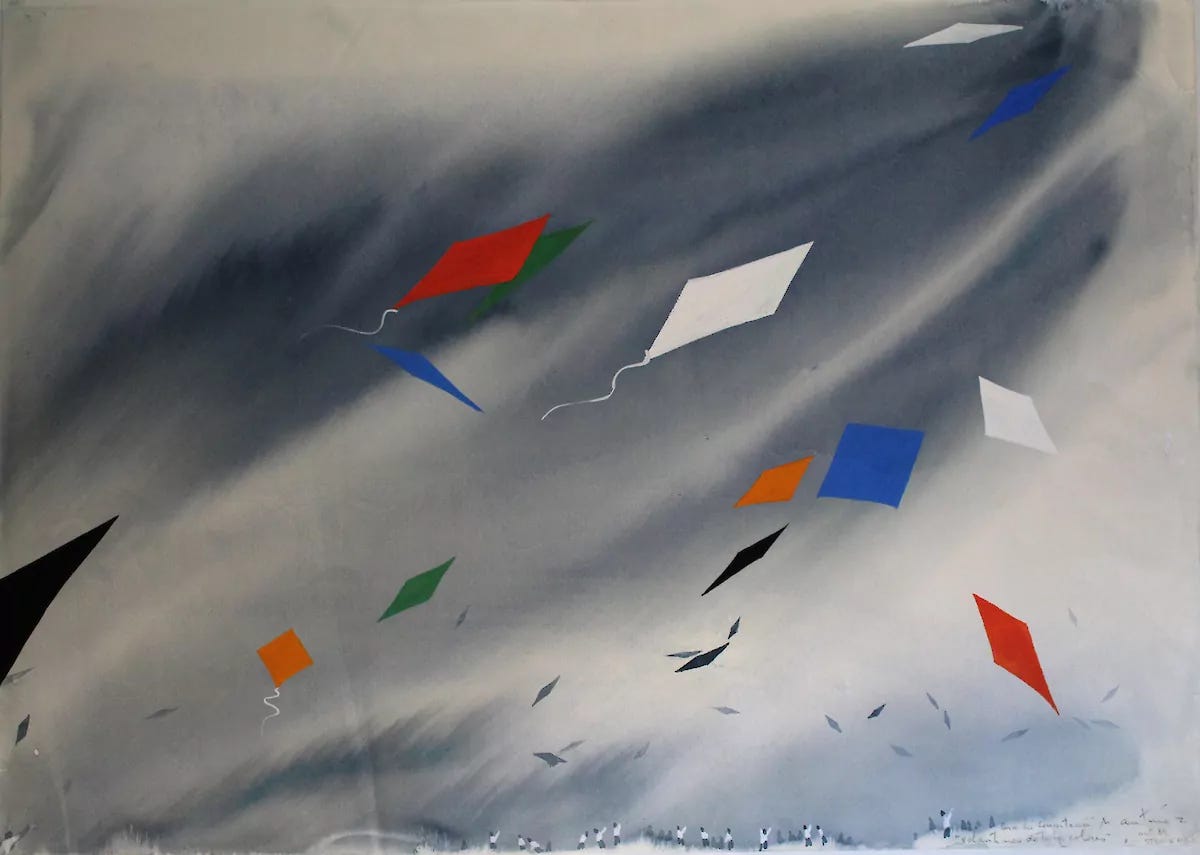
Nemesio Antúnez, Kites of Many Colors, 1989.
Mark Fisher, the cultural critic who died in 2017 before finishing what would likely have been his most important book, drew a distinction nobody in UAP theory has picked up, and it belongs precisely here.
Fisher split uncanny experience into two kinds. The weird is the wrong presence: something that shouldn’t be here, an intrusion of the alien into the familiar. The eerie is stranger and harder to name: the wrong absence, or the wrong agency. The sense that something should be here and isn’t, or that there’s agency where there shouldn’t be any. Action with no visible actor. Intention with nobody to locate as the intender.
