
The Threshold [pt. V]
Signs, Symbols, and the Language of the Phenomenon

Author’s Note:
Part 4 ended with a question: if the dual signature is real — if the phenomenon writes itself simultaneously on body and culture, on matter and meaning — in what language is it writing?
The answer is going to sound, at first encounter, like a retreat into mysticism. I want to be precise about why it isn’t. The phenomenon communicates in symbols not as a choice, not as a limitation, but as a structural necessity imposed by where it exists in the architecture of reality. Symbolic communication is not primitive. It is not what you use when you lack the technology for something better. It is the only medium capable of operating at the layer where the dual signature originates.
This installment works through why, drawing on Ernst Cassirer, Susanne Langer, Mircea Eliade, and the biosemiotician Terrence Deacon. By the end, the dual signature will look less like a strange feature of the contact literature and more like a structural consequence of what the phenomenon is.
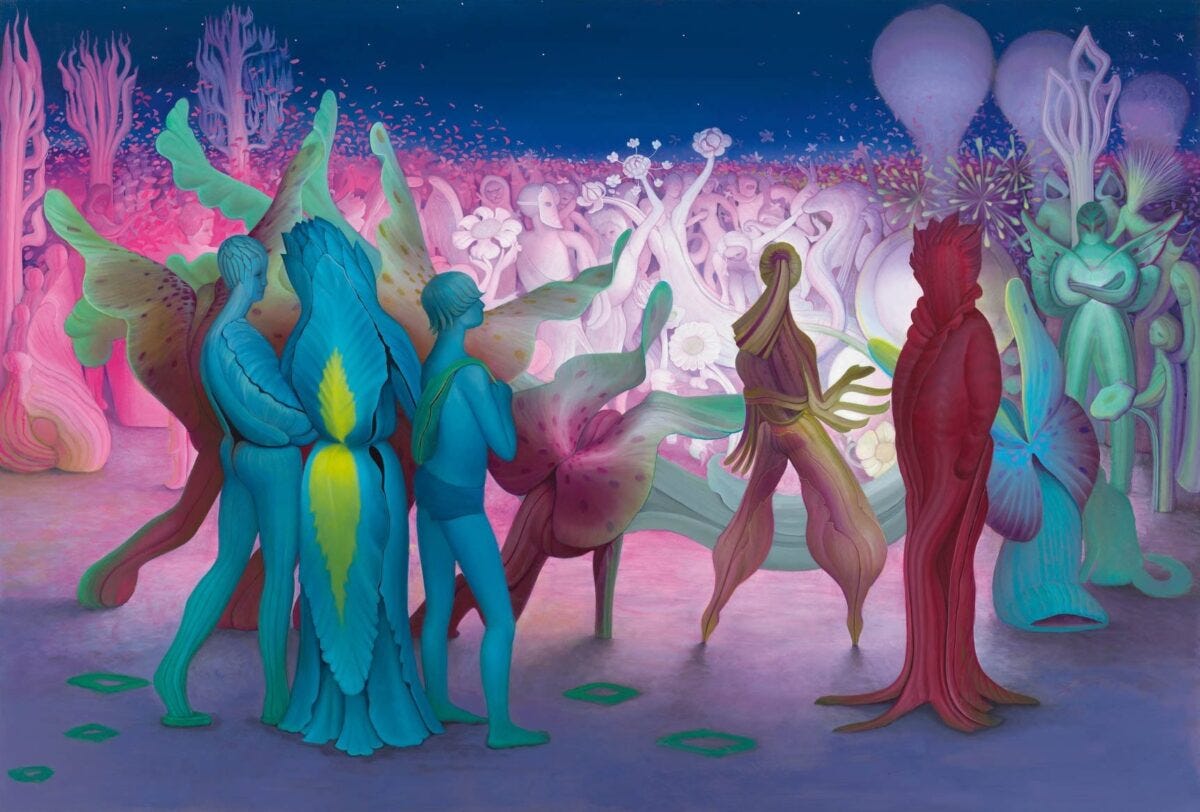
Inka Essenhigh, Rave Scene, 2022.
Part Two ended with a question: if the phenomenon writes itself simultaneously on body and culture, and on matter and meaning (if the dual signature is real and consistent and cross-cultural) then in what language is it writing?
This is the question that has been waiting underneath every other question in this series. Not what is the phenomenon and not where does it come from, but what is it doing, and how.
The answer I want to propose is one that will sound, at first encounter, like a retreat into mysticism. I want to be precise about why it isn’t.
The phenomenon communicates in symbols.
Not as a choice. Not as a limitation. As a structural necessity. It is the only available medium for an intelligence operating at the layer of reality where the dual signature originates. Symbolic communication is not primitive. It is not imprecise. It is not what you use when you lack the technology for something better. It is the only medium capable of operating below the subject-object split, at the substrate where matter and meaning have not yet differentiated into the separate categories that make propositional communication possible.
To understand why, we need to make a distinction that most people learn and immediately forget, because it seems academic until the moment it becomes the hinge on which everything turns.

Inka Essenhigh, Yellow Breath, 2022.
Signs and Symbols Are Not the Same Thing
To understand why the phenomenon communicates the way it does, we need a philosopher rather than a physicist
A sign carries information. It points at something other than itself, delivers a fixed meaning, and leaves the receiver unchanged. Exit means exit. The arrow on the road means turn here. The fever reading means the body is fighting infection. You receive the sign, extract the content, and remain the same person you were before you encountered it. Signs are transactional.
A symbol does something categorically different. A symbol cannot be received without changing the receiver. This is not a poetic observation. It is the structural definition of the symbol as Ernst Cassirer established it in Philosophy of Symbolic Forms (1923–1929). It is the most rigorous account of symbolic consciousness produced by twentieth century philosophy, and one that UAP theory has, as far as I can determine, entirely ignored.
Cassirer’s argument was this: human consciousness does not have direct access to reality. It has access only through symbolic forms: language, myth, art, science, and religion. These are not filters or distortions placed between the mind and the real. They are the structures through which the real becomes experienceable at all. Without symbolic form, there is no experience, only undifferentiated flux.
