
What Cannot Be Classified
On disclosure, the quiet witnesses, and what Disclosure Day gets right about it.

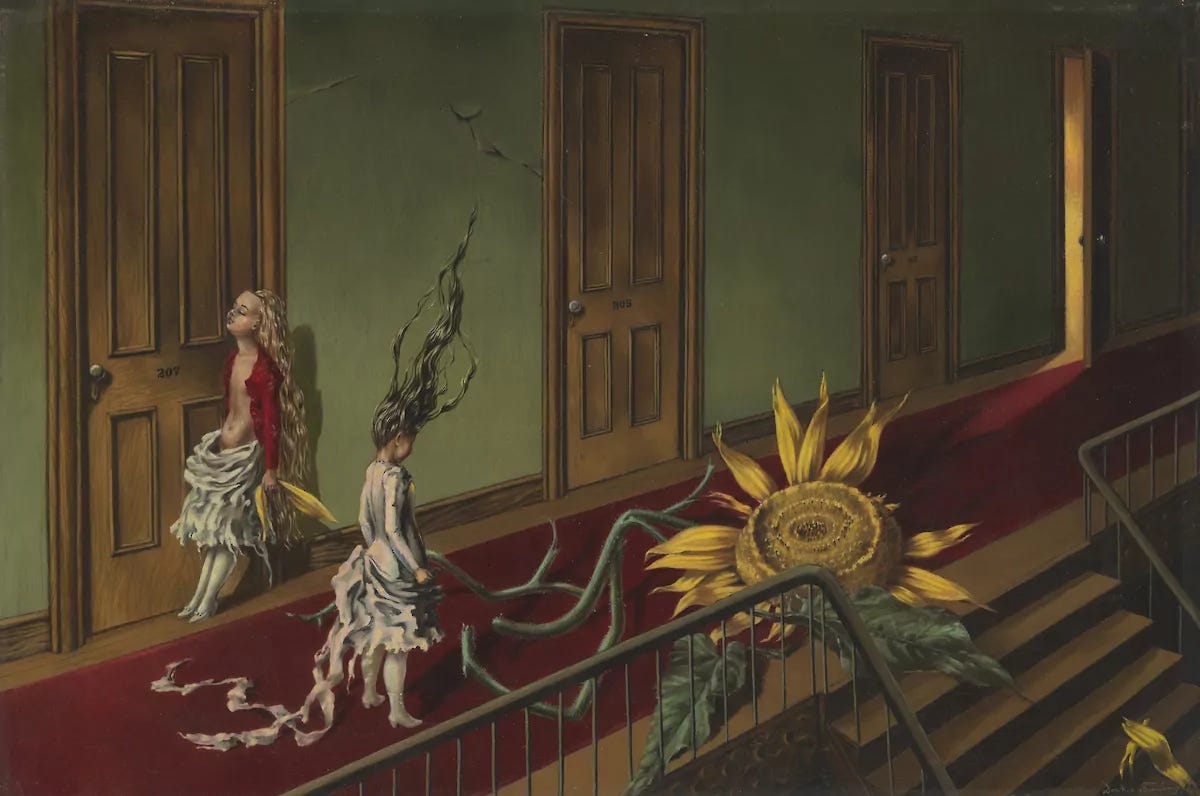
Dorothea Tanning, A Little Night Music, 1943.
A quick note before we start:
This piece braids together three things I have been turning over this month: what we actually mean by the word disclosure, my own mixed feelings about the Disclosure Day movie, and a few takes on that film from experiencer writers I admire, for anyone who would rather hear a chorus than just me.
The Threshold series picks back up next Sunday, for paid subscribers. If you are new here, or you just want the whole argument so far in one place before it continues, start with the recap: READ THE SUMMARY SO FAR.
There’s a particular electricity in the air this month. Files are being released on Friday afternoons. People are refreshing government websites. A Hollywood movie about experiencers is in theaters. A president may or may not be about to say the sentence that changes everything. Everyone is waiting for the drop.
I keep noticing that the people who have spent the longest inside this question seem the least interested in the drop, and the most interested in a prior question almost no one is asking. I want to ask it here, because I think the whole frenzy rests on a category error.
The Word Nobody Defines
Start with the word itself. Disclosure. We pass it around as if we agree on what it means, and we don’t.
If it means these things are physically real, that there is something in the sky behaving in ways our instruments cannot explain, then that ship sailed a long time ago.
The summer of 1952, when something held over Washington for hours, on radar and in plain sight, while fighter jets were scrambled to chase it, was disclosure. So was every radar-confirmed military encounter in the decades since. If the bar is “real”, we cleared it before most of us were born, and refreshing the page on a Friday won’t clear it any harder.
But notice what we are actually doing when we wait for a government to release the truth. We are assuming the truth is a thing that can be possessed, and therefore handed over. We are assuming there is an object, sitting in a vault, owned by someone, waiting for permission to be seen.
That is the category error, because the most important part of this was never an object, and was never anyone’s to own.
You can stamp SECRET on a photograph. You cannot stamp it on a memory. You cannot classify a wound, or a three-in-the-morning recognition that the world is not shaped the way you were told. The most heavily classified material in this entire story has been sitting, unclassified and unread, inside the bodies of ordinary people the whole time, and no vault on earth contains it. An experience cannot be released to you. You can only have one, or stand close enough to someone who has.
Which means the thing people are really waiting for, to be given the phenomenon, is not a thing that can be given. It belongs to everyone, in the only way that matters: by happening to anyone, anywhere, without asking the state’s permission first. The nature of reality belongs to all of us.
The Witnesses, and the Skeptic
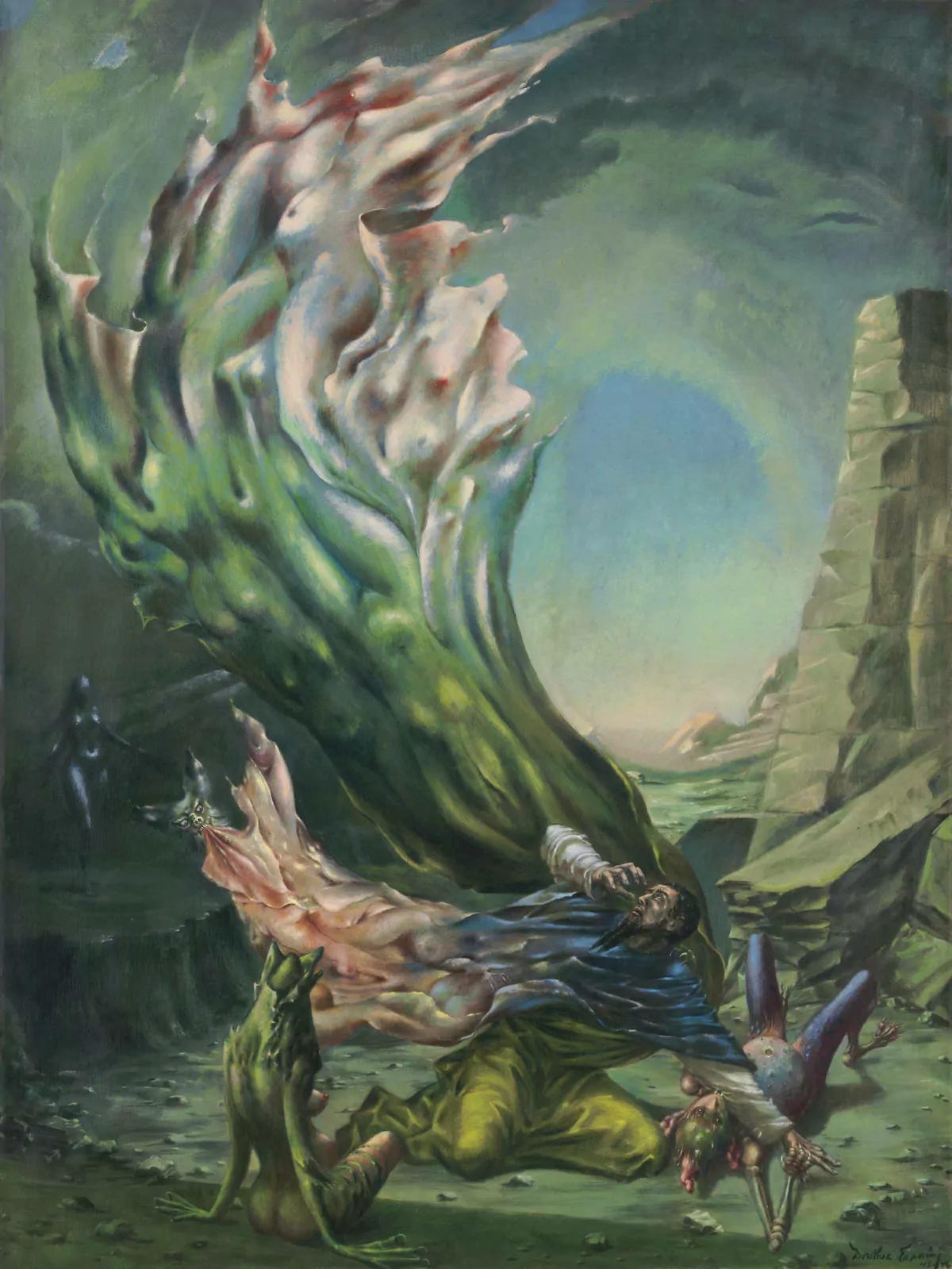
Dorothea Tanning, The Temptations of St. Anthony, 1945.
So let me make the case for the people the whole apparatus keeps stepping over.
The skeptic says: testimony isn’t evidence. And the skeptic is half right. A single account wavers. Memory edits itself in the retelling. A lone witness, pressed closely, will often contradict their own story.
Here is the half the skeptic misses. Testimony that is patiently gathered, cross-checked, and structured stops being an anecdote and becomes an archive. One account is a rumor. Ten thousand accounts, indexed and compared, are a dataset.
The largest and richest body of data this field possesses is the testimony of ordinary people, and we throw nearly all of it away. Not, if we are honest, because it isn’t real. But because it doesn’t fit the instrument. And when your data doesn’t fit your instrument, a true scientist builds a better instrument. They do not burn the data to protect the machine.
Modern epidemiology was born this way. John Snow traced a cholera outbreak to a single London water pump years before the science could see what was actually doing the killing. The record of who fell ill, and where, was the data. The pattern came first. The mechanism came decades after. Nobody waited for a better microscope before taking the handle off the pump.
That is how most new knowledge arrives. Someone reports an impossible thing, and risks the ridicule that comes with it, and everything turns on whether the rest of us keep listening long enough for the pattern to surface.
I trained as a nurse, and I work now in health informatics, which is a formal way of saying I spend my days on the problem of how a human experience becomes flattened into a record. What I kept noticing at the bedside was how much got carried, silently, all the way to the threshold. The near-death experiences. The visitations. The encounters at the very edge of dying that patients would describe to me once, carefully, and never again. Because there was no field on the chart for them, and no one had thought to build one.
That is the whole problem in miniature. We are not short on signal. We are short on fields for it.
What Art Knows That Radar Doesn’t
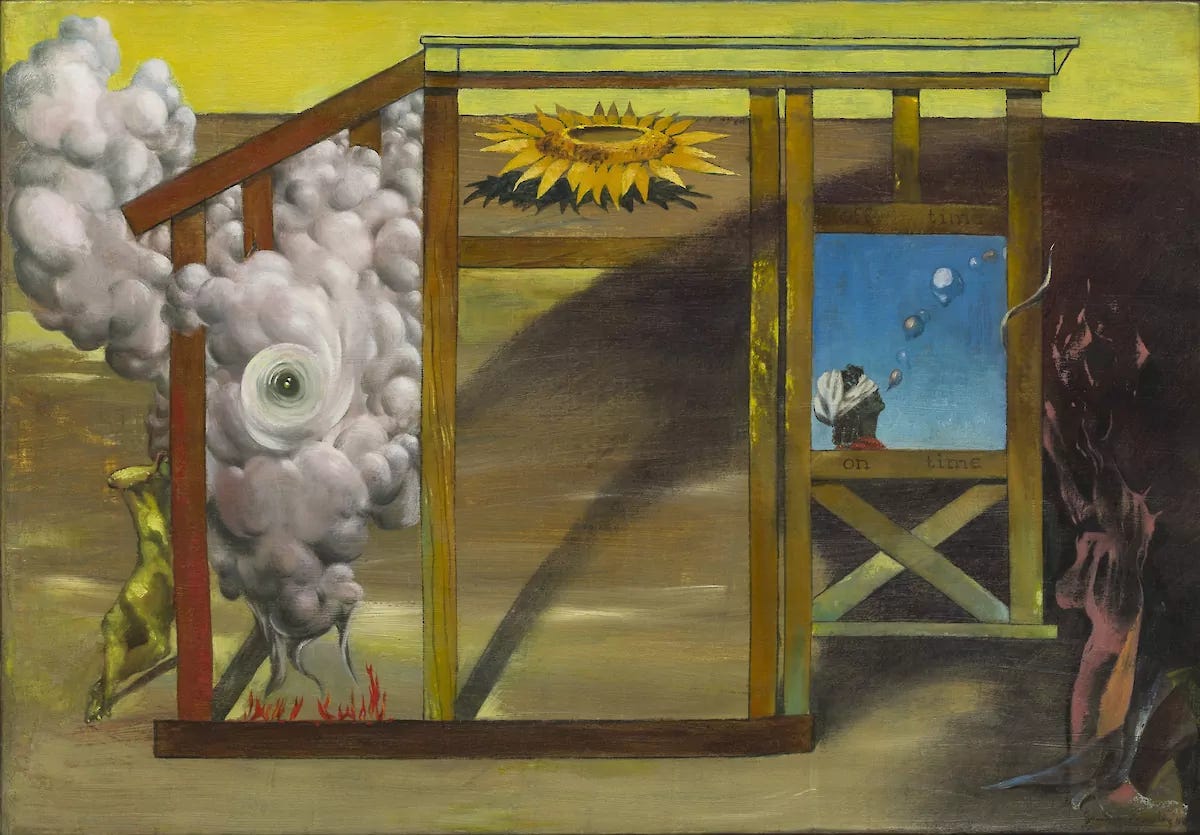
Dorothea Tanning, On Time Off Time, 1948.
So why not simply collect the testimony better and be done? Because the hardest part was never collecting it.
An instrument can measure the distance between us and the phenomenon: the speed, the altitude, the burn in the soil, the smear on the tape. What no instrument can record is the qualia: what it was actually like, from the inside. And most honest witnesses will tell you the inside was the part that reorganized them, and broke them open to a new understanding of reality.
Ordinary language has the same trouble, in a quieter form. Words work by naming, and to name a thing is to stand back from it far enough to pin a label on it; it is to set it beside everything else you have already named. The moment you say I saw a light, you have moved a pace away from whatever the light actually was to you. The word arrives and the thing slips behind it. It is part of why witnesses go quiet, or apologize, or trail off. They have the words. The trouble is that the words keep walking them away from the place they are trying to stand.
Art is the odd exception. A poem is made of the very same words, and yet it does not stand back and label. It tries to put you inside the thing instead of at a name’s distance from it. It is a refusal to file the experience away and reach for the next one. It is the one use of words that stays close instead of pulling away.
An image, or a few bars of music, can do the same: they do not point at the experience from across the room, they reach for the thing itself. And that is why art can carry what both the instrument and the plain sentence lose. It lives in the same place the experience does, in the felt, undivided moment before the naming starts. So when a witness reaches for metaphor, for something that sounds vague or strange or too poetic to take seriously, they are usually not being imprecise. They are being as precise as the experience will allow. You describe an encounter the way you describe a piece of music, or a face: not by listing its measurements, but by trying to catch what it was like to be in the room with it.
This is also why the strangeness is worth keeping rather than apologizing for. The absurd details that cling to these encounters, the parts too silly to repeat, the events that seem almost staged to embarrass the witness, are usually the first thing people edit out to sound credible.
But the absurdity may be doing something. A tidy, plausible signal gets sorted into a box you already have. A genuinely impossible one cannot be filed, so you carry it around for years, like a splinter in consciousness, turning it over, unable to make it sit still. The strangeness might be the part that keeps the experience alive in you long enough to matter.
The poet Keats had a name for the capacity this requires. He called it negative capability: the willingness to stay inside uncertainty and mystery without grabbing prematurely for an answer. We tend to treat that as a soft, literary virtue. Here it is a hard requirement. The phenomenon punishes the impatient grab. It rewards the ones who can stay in the not-knowing long enough to see something. Which may be why artists and experiencers so often catch what the committees, for all their funding, keep walking past.
The Self Is Not as Sealed as We Think
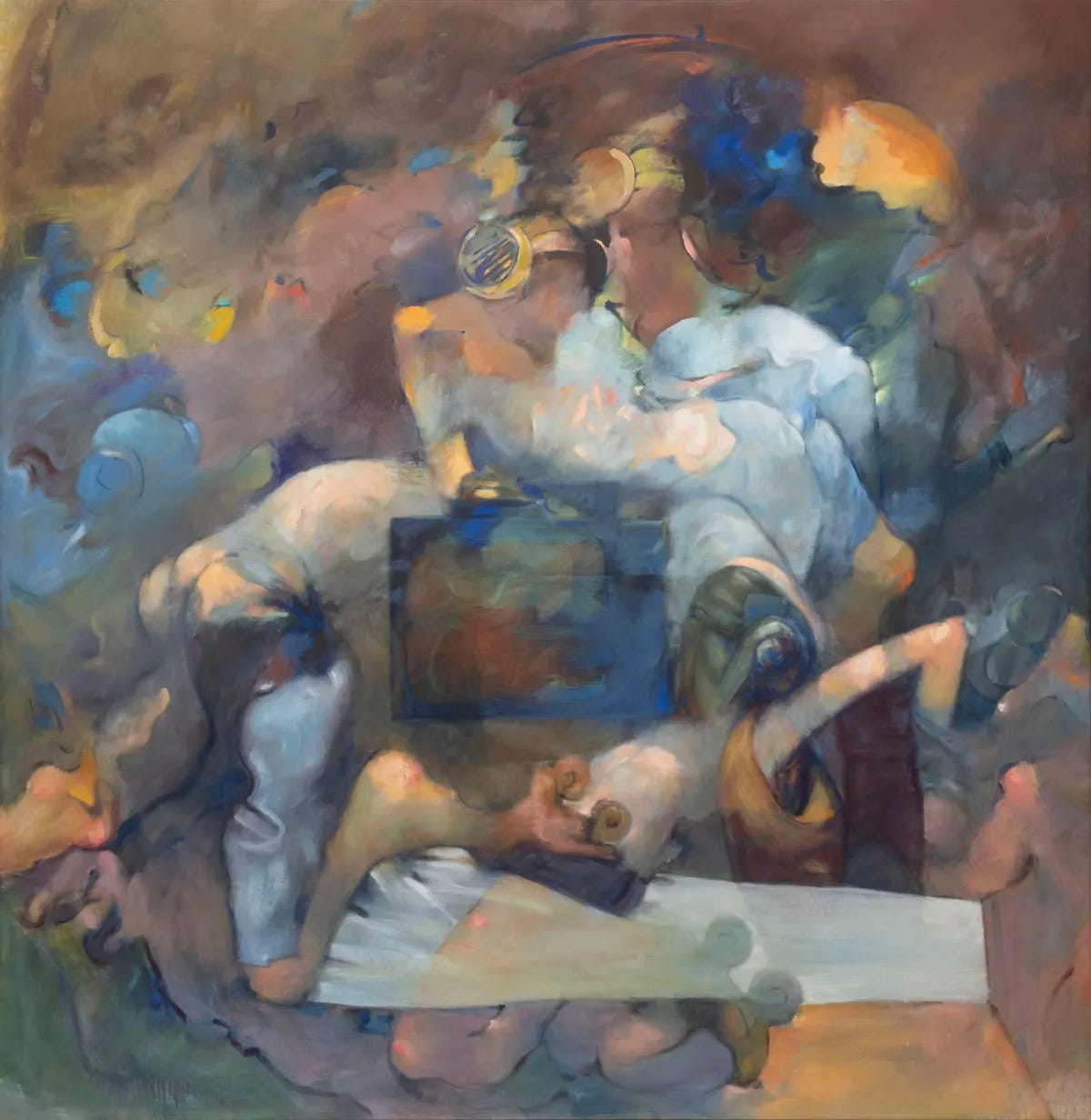
Dorothea Tanning, Pounding Strong, 1981.
And what is it that the experiencers catch? The same thing, reported again and again across cultures and centuries: that the sealed, sovereign self is not as sealed as we assume.
Most of us move through life as if we were shut in. A single consciousness locked inside the dark of the skull, looking out at a world that is plainly not us. The encounter tends to break that assumption. Up close (and contact is about as close as it gets) the line between the one looking and the thing being looked at stops holding. People rarely describe meeting something cleanly outside themselves. They describe the boundary going soft. Being known from the inside. Recognized. Met at a depth that nothing merely external should be able to reach.
If that sounds like mysticism, physics ended up in the same place. At the smallest scale, the clean separation between the observer and the observed does not hold; the act of looking takes part in what is seen. We allow this, grudgingly, when it is said about a particle or a wave. The phenomenon says it about us, at human size, and asks us to hold two things at once that the orderly mind would rather keep apart: it is out there, and it is also in here. Both at the same time.
What it seems to ask is that we stand in the space between those two facts without collapsing it to one side, because that in-between, where inner and outer have not yet been split into opponents, looks like the place this actually lives.
Are We Meeting Ourselves?
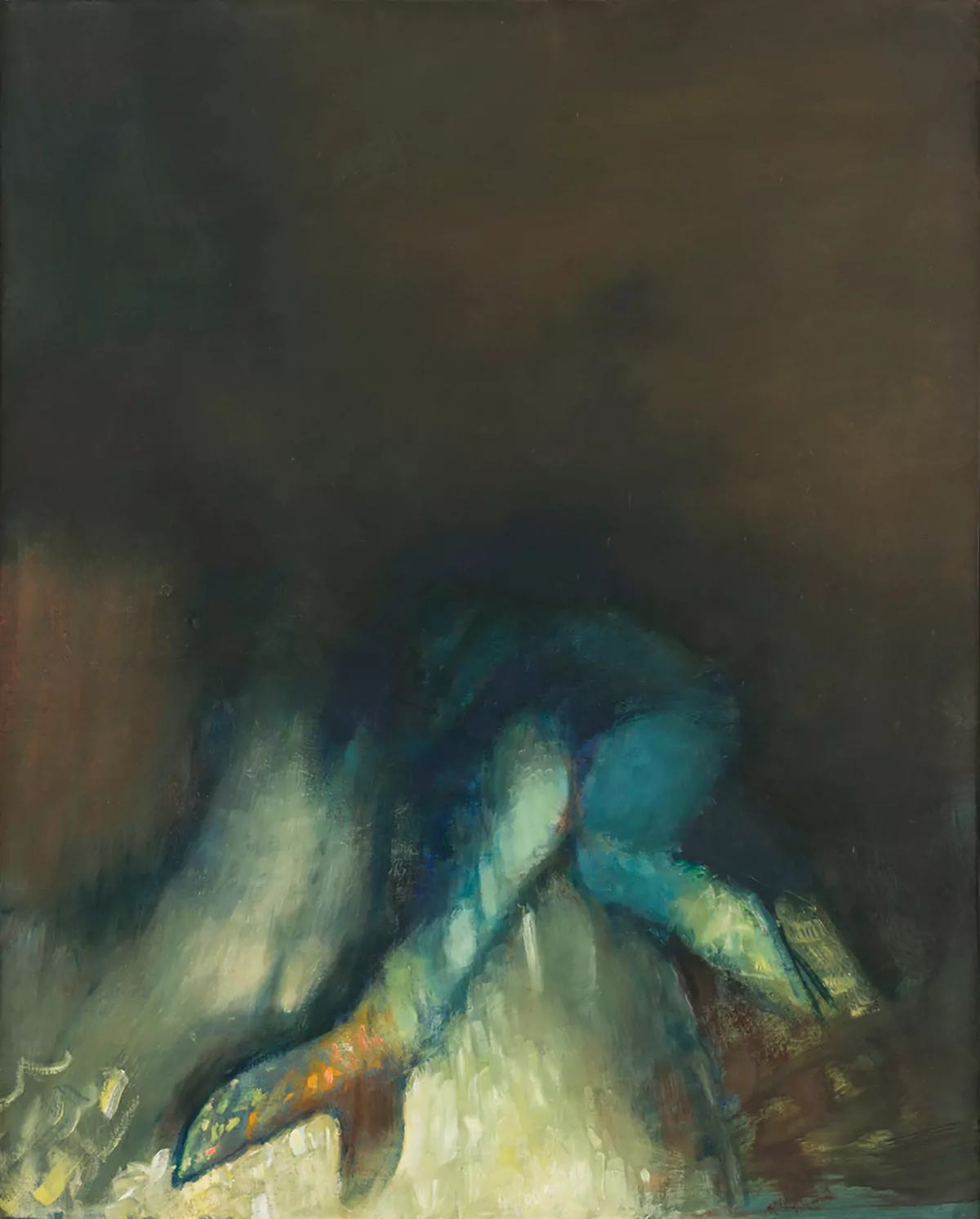
Dorothea Tanning, Dantedore II, 1983.
There is something else people report. They come away feeling they were not simply watching the thing, that it was, in some sense, responding to them. Meeting them. Now and then handing back something that felt like their own fear, or their own longing, or some piece of themselves looking back. Not everyone, and never the same way twice. But it happens often enough to sit with, and it raises a possibility the whole machinery of capture and classification has no way to hold: that what we are trying to pin down may be, in part, a mirror. That the effort to seize it and the effort to know ourselves might be closer to the same task than we assumed.
So here is the possibility underneath all the others. The boundary we are working so hard to declassify may not run between us and them at all. It may run straight through the middle of us. And the deepest disclosure, the one no president can grant and no agency can withhold, might be the moment we get close enough to see clearly and find that we were never only looking outward.
That cannot be classified. It never could be. It belongs to everyone. Not as a gift from a government that finally decided to be generous, but simply as a fact of what it is. Anyone who has stood at the threshold and seen something the chart had no field for already has it.
What we owe each other now is not a leak. It is permission. Permission to take the witnesses seriously. To let art carry what the instruments cannot. To stay inside the uncertainty without rushing to resolve it. And to consider, seriously, that the strangest thing in the sky may also be the one most willing to show us our own face.
Disclosure Day
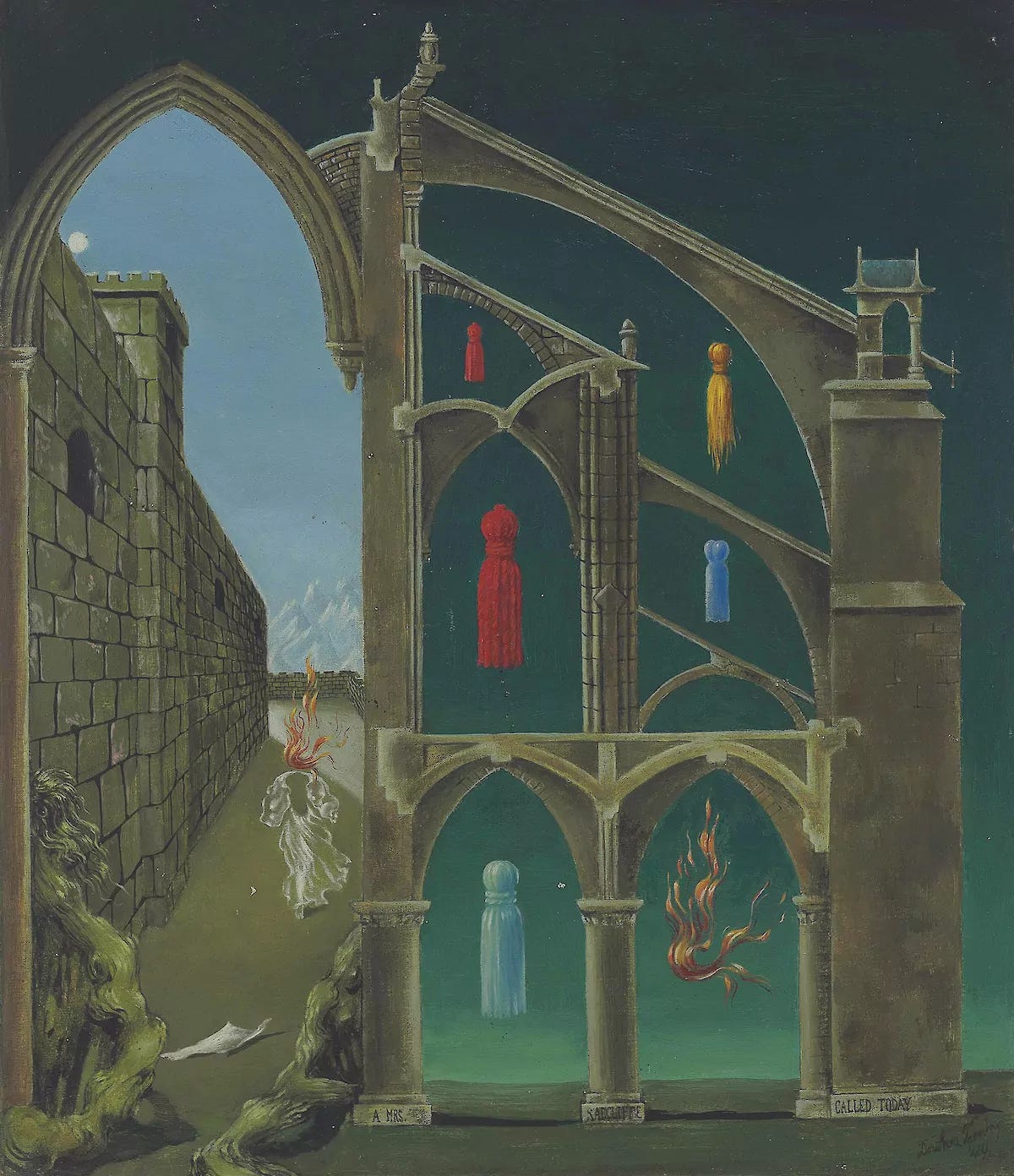
Dorothea Tanning, A Mrs. Radcliffe Called Today, 1944.
Earlier I said you can only have an experience, or stand close to someone who has had one. A movie is a third, stranger option: it tries to stand a whole dark room close to one at once. That alone makes even a clumsy movie worth a look.
I wasn’t thrilled with Disclosure Day, but I didn’t hate it either. That lukewarm middle is most of why I’m not going to write a whole essay on it. But I said I’d share my thoughts, so here they are.
Corny and cluttered, and the seams show. It feels rewritten, and maybe rushed out while real disclosure was in the news. I can’t confirm that; it’s a guess from how muddled it is. But a movie can be weak as a movie and still matter as an event, so I’m not ready to wave it off.
It plays less like a story than like information packaged as a movie. More a delivery system than a plot.
It works like a gateway drug for belief. Fiction lets people try on an idea without committing to it, which is often how the line moves on what’s acceptable to think. Here the nudge is away from flat materialism and toward a world with other minds in it.
The part that landed for me: it got a lot of the experiencer’s inner world right. The way it often starts in childhood. The memory and the trauma. The way these experiences show up in the body. That is the part no chase scene could fake. And the word “experiencer” is now in the popular lexicon.
That last line is the part I keep coming back to. Before “experiencer” was in wide circulation, anyone who lived through one of these encounters was just a person with no category, easy to file under “unwell” and move past. Now there is a name for it, and a rough two-hour sketch of how it feels from the inside, sitting in the popular imagination where nothing used to be. That is the window moving, and it is why I can’t dismiss the film on artistic merit alone. A polished one that left the word out would have done less for the witnesses than this messy one did.
Other ways of seeing it
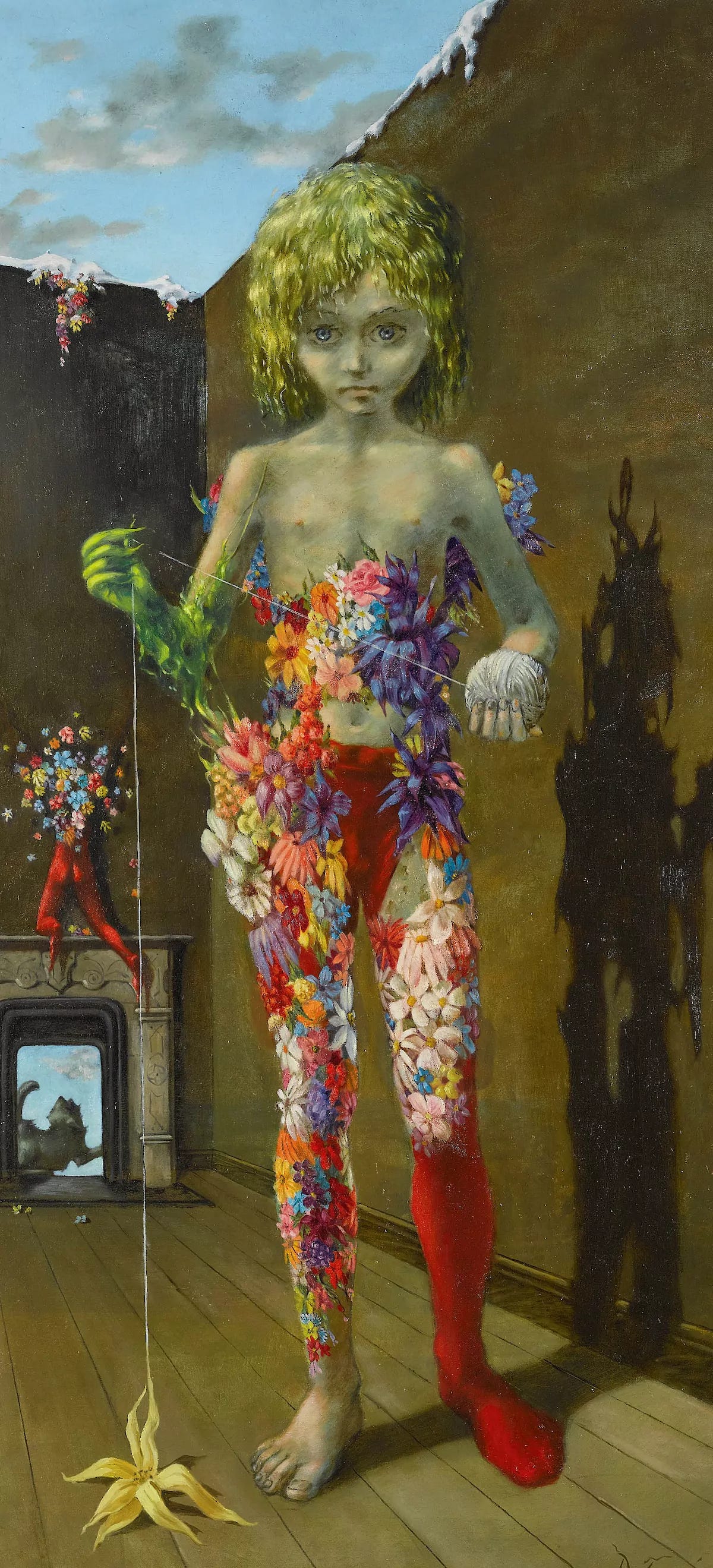
Dorothea Tanning, The Magic Flower Game, 1941.
There are already more takes on Disclosure Day than anyone could read, and I would rather hand you a few I love than add one more full essay to the pile. Three experiencer writers I admire, each catching something the others don’t:
Courtney Buterbaugh, For a moment, we were all experiencers. On the film as a rare act of empathy and visibility. It says the word experiencer out loud, sets that reality inside the ordinary human stuff of childhood and memory and the things we never say, and, in the hush as the credits roll, briefly puts a whole theater inside the experiencer’s point of view.
Samantha Leifker, Thoughts on Disclosure Day: An Experiencer’s Perspective. Grateful and discerning at once. She welcomes seeing screen memories and the animal archetypes reach a wide audience, pushes back on the idea that other intelligences threaten faith rather than deepen it, and wonders whether real disclosure is less about we are not alone than about something dormant in us, all while staying alert to the narrative the film is quietly seeding.
Whitley Strieber, The Hidden Meaning of Disclosure Day. A mythic reading that follows the film’s buried Hansel and Gretel thread, where the kindly old alien and the starving witch turn out to be the same figure, the predator as exposed as the prey, and contact less a rescue or a doom than a wary dance between two lonely parties in a very cold universe.
Mike Clelland, Disclosure Day and my novel, The Unseen. A novelist and experiencer who walked out realizing the film kept hitting the same oddly specific beats as his own 2023 novel: two young psychics, one of them named Daniel, a fox, a cardinal, two people paired in childhood by the visitors for a role they grow into. He reads the overlap not as anyone copying anyone, but as synchronicity, two storytellers reaching into the same shared field and coming back with the same images. (Spoilers for both the film and his book).
Nicole VanDenEng, Disclosure Day: A Loaded Zeitgeist. Written before she had even seen it, from the vantage of someone who works in books and watches how stories move a culture. Her read is that a film like this is never just a story but a deliberate, gentle delivery system: it hands the public the word experiencer and a set of images that will surface dormant memories, with enough deniability that anyone who needs to can still call it fiction. The specifics of the plot, she argues, barely matter next to the shift in the zeitgeist.
Read them, and notice that four people who have lived this walked out of the same hundred and twenty minutes holding four different films, and a fifth felt the whole thing coming before she had seen a frame. What you bring decides what you see, which is the thread running through everything above: get close enough to anything strange and the line between what you are looking at and what you are starts to blur. A movie, in the end, is the culture reaching for the one thing that can carry a feeling instead of a fact, which is why even a clumsy one can matter. The same goes for the testimony. When an account comes out strange and lyrical, too poetic to quite trust, that may be the one getting closest to what happened, because it is reaching for the feeling instead of filing the fact. Both are trying to hand people an experience rather than a file, and an experience is the only kind of disclosure there ever was. So if you want, go sit in the dark with it yourself and watch what it does to you. That part was always yours.
If this resonated, you’d likely find your people in the Discord: a growing community for the stranger end of the phenomena, the philosophy under it, and the experiencers living it. We go deeper in real time. JOIN HERE.
New to The Maze to Metanoia? SUBSCRIBE to follow along, and feel free to SHARE this article as well:
The experience is yours. The silence is optional.
I love how you put this. Beautifully said. Disclosure isn't really about the declassification of physical evidence, but about encountering something that cannot be categorized, boxed in, or fully explained or comprehended. The true nature of reality reaches so far into the strange unknown. And it's so important that those seeking true disclosure look to the experiencers themselves, rather than relying solely on the news or government authorities to convey something that those who have actually witnessed the phenomenon firsthand can barely begin to describe.
I like that you discuss the messy, individuality of experiences, and then accentuate that by showing several angles from experiencers. It highlights the importance of the collective. Our stories complete one another, and looking at our multitude, our interpretations, our meaning-making, we can see something vast that leaves no stone unturned.
(The art is really stunning in this one, too.)