
The Threshold [pt. IX]
The Trickster and the Adaptive Intelligence

Author’s Note:
The argument, built across this series so far, is that the phenomenon is a single source: an intelligence native to the informational substrate of reality, communicating in symbolic language through the aperture of threshold states, producing the same dual signature across every culture and every century.
I’ll be presenting a version of that argument at Anomacon on September 12, in a talk called “The Threshold: Making Room for the Extraordinary”.
The premise of the talk (and the series overall), in short: for a century we’ve treated extraordinary experiences as things to explain away, and this series is what happens when you set that reflex down and look again, from outside our usual human-centered view of the world.
But the fairy court of medieval Europe looks nothing like the grey alien of the twentieth-century American contact narrative. The seraphim of Isaiah look nothing like the machine elves of the DMT laboratory. The aerial ships reported in ninth-century chronicles look nothing like the structured craft documented by Hynek and Vallée. The content, the imagery, the specific vocabulary of contact, all of it changes dramatically across centuries and cultures.
If the source is single and the operation is invariant, why does the surface vary so wildly?
It’s a genuine weak point, not a rhetorical setup. It’s the place every unified theory of the phenomenon has to answer for, and none of them do it well.
The surface variation isn’t evidence against a single source, rather, it’s evidence of something about that source that no other framework has reckoned with.
The phenomenon is adaptive. It updates its symbolic vocabulary in real time, tracking the evolution of human consciousness with a consistency and precision that, once you see it, you can’t unsee.
That’s this essay’s central claim, and I think the series’ most unsettling one so far. Because if it’s right, the implications run past what the phenomenon is. They run to what we are, and what our relationship to the phenomenon has actually been across the whole of recorded human history.
The Trickster Vallée Noticed
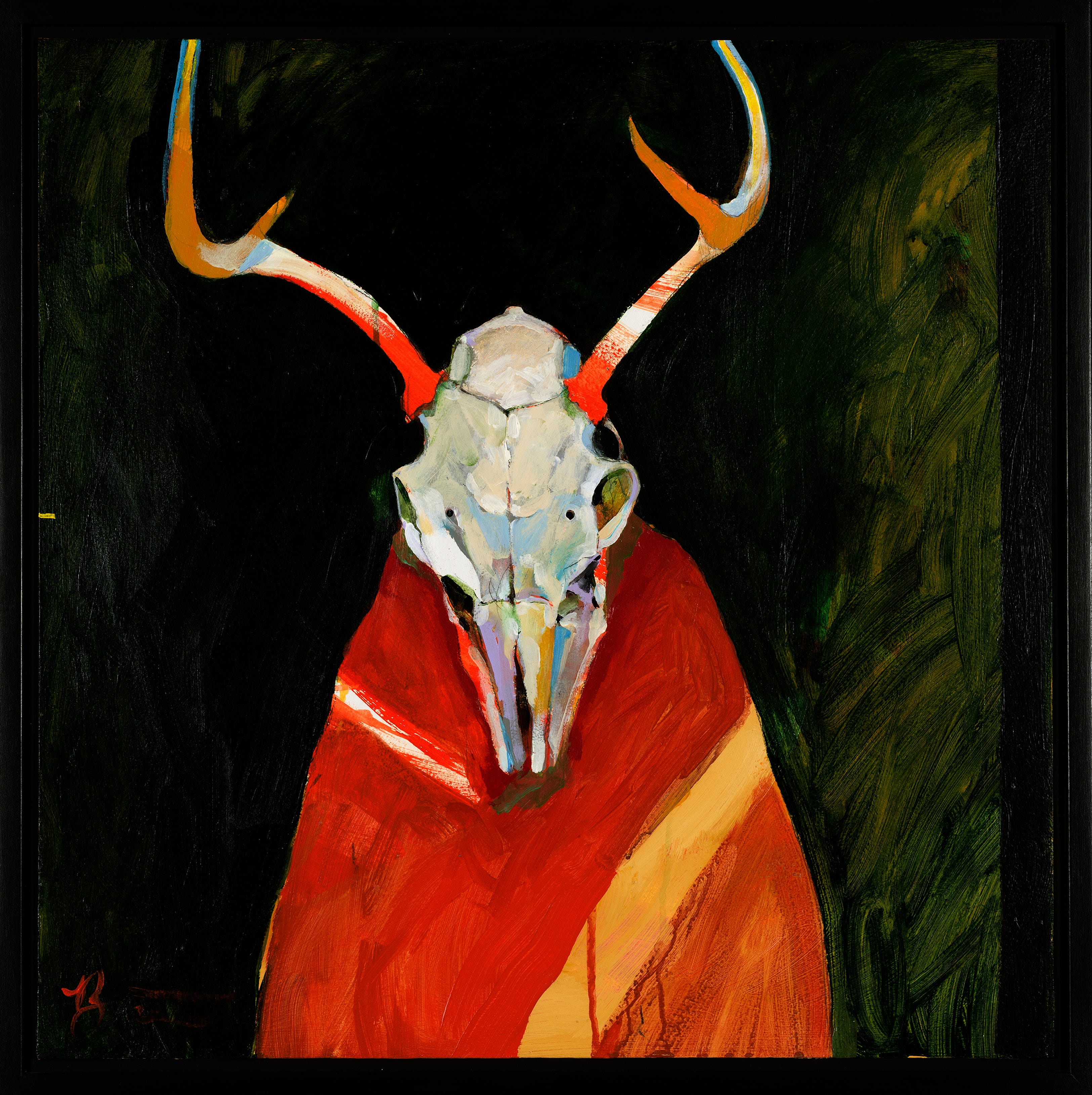
Rick Bartow, Deer Spirit for Frank LaPena, 1999.
Vallée named it. He called it the trickster quality: the shape-shifting, the elusiveness, the way the phenomenon stays perpetually one step ahead of any framework built to contain it. He documented it exhaustively across case files spanning centuries and recognized it as a defining feature of the phenomenon, not a peripheral quirk.
But he couldn’t explain it. His trickster archetype was descriptive, not mechanistic. It named a pattern without accounting for it.
Here’s where I want to start: the distinction Part V established between a sign and a symbol, which turns out to be load-bearing for everything that follows.
A sign can be received without changing the receiver. A symbol cannot. The symbol operates at the layer of experience before propositional processing, and at that layer, reception and transformation are the same event.
Part V didn’t push this far enough, though: a symbol that’s been fully domesticated into a category is no longer a symbol. It’s become a sign.
The first time a culture meets the grey alien (the large-eyed, spindly-limbed, telepathic figure that began appearing in American contact reports in the late 1950s and accelerated sharply after the Hill case) it’s a symbol. It operates below the threshold of categorization. The receiver can’t slot it into an existing schema. The encounter is irreducibly strange, symbolically live, and transformatively powerful.
The aperture stays open, and the transmission gets through.
But culture is a categorization machine. Within a few decades, the grey alien is domesticated. It’s on t-shirts and coffee mugs. It anchors a whole television genre. It becomes the default visual shorthand for “alien” in a civilization that has never officially met one. The symbol becomes a sign. Now the receiver can file the image away (“alien, yes, I know what that is”) without being transformed by it.
And here’s a detail that should stop you: classic abduction reports, the Strieber-and-Hopkins-and-John-Mack style encounters that defined the genre, peak almost exactly at the moment the grey alien goes fully mainstream in the early-to-mid 1990s, and then fall off a cliff.
Researchers have offered plenty of conventional explanations for the decline: better cameras, a more skeptical media, or the culture simply moving on. But the timing is hard to ignore if you’re reading it through this framework. The costume didn’t stop working because people stopped seeing things. It stopped working because it stopped being a symbol. Once the grey alien became a sign, it lost whatever it had that let it get through, and the phenomenon had to go looking for a new one.
So the phenomenon updates.
The trickster shifts shape. Not randomly, but strategically, to the edge of the receiver’s current ability to categorize. To the place where the left hemisphere’s filing system runs out of folders. To the territory just past what the culture has successfully domesticated into a sign.
That’s the necessary behavior of an intelligence whose only available medium is the symbol, and whose symbols lose their charge the moment they’re successfully categorized. It can’t communicate through familiar imagery, because familiarity is precisely what kills the symbolic charge that makes communication possible.
So it stays at the edge. Not because it’s playing games, but because that’s how it maintains the conditions for contact to continue.
