

The Second Taboo
What the John Mack Institute symposium revealed about experiencers, institutions, and the future of care

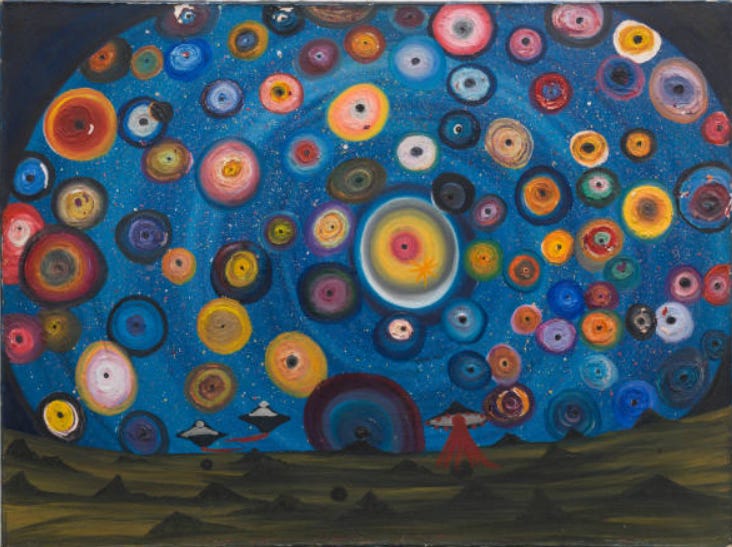
Ionel Talpazan, Untitled, 1995.
Part I of II:
Medicine often learns to recognize forms of human suffering long before it learns how to explain them.
Patients lived with chronic pain before pain became something healthcare measured systematically. Families carried the invisible wounds of war before post-traumatic stress disorder entered the diagnostic manuals. Hospice existed in practice before palliative care became a discipline. Moral injury, spiritual distress, narrative medicine, adverse childhood experiences, post-traumatic growth: again and again, the experience came first and the language came later.
This is not a failure of medicine. It is the history of how knowledge grows. Healthcare rarely expands because human beings suddenly begin suffering in new ways. It expands because clinicians, researchers, and communities learn to recognize dimensions of suffering that were already present but had not yet become visible as coherent objects of care.
Recognition precedes explanation.
That was the thought I kept returning to after attending the John Mack Institute’s online symposium, Breaking the Taboo: Reviving Academic UAP, Abduction, and Experiencer Research, co-sponsored by Rice University’s Center for the Impossible.
The title was accurate. The academic taboo surrounding anomalous experience is real, and the symposium made a serious contribution to breaking it. Across several hours, philosophers, clinicians, researchers, experiencers, archivists, and legal scholars gathered around a subject most institutions have preferred to dismiss, ridicule, sensationalize, or ignore. But the symposium did more than revisit an old controversy. It revealed a field changing shape.
The old question was whether experiencers should be believed or dismissed. The better question, and the one that organized this day, is how institutions should respond when human experience exceeds their existing categories. That shift moves the conversation past the exhausted binary of credulity versus skepticism and toward something more durable: recognition, method, ethics, documentation, and care.
A field is not born when everyone agrees on what something is. A field is born when enough people agree that something deserves sustained attention.
That, more than anything, is what the symposium made visible. Archives are being built. Clinical models are emerging. Philosophers are refining the ethical questions. Researchers are asking how to measure aftereffects. Experiencers are refusing to remain objects of interpretation. Peer-support communities are doing work institutions have neglected. Legal scholars are testing what human categories of harm and consent can bear.
This is not a settled field. It is something far more interesting. It is a field in formation, and field formation always reveals institutional absence.
Several days later, I realized I was no longer thinking primarily about unidentified aerial phenomena, or abduction accounts, or even John Mack.
I was thinking about healthcare.
Care Before Certainty
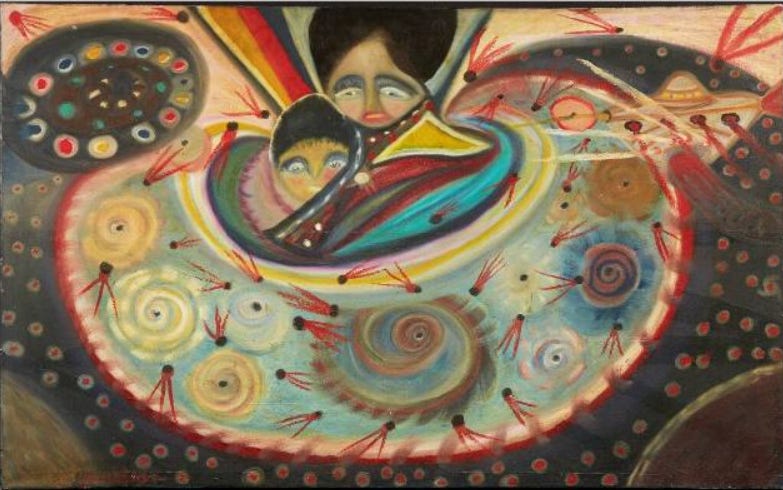
Ionel Talpazan, Father and Son in Space, 1992.
People undergo experiences that reorganize their sense of reality, identity, meaning, safety, trust, and belonging. Those experiences may be anomalous, traumatic, mystical, relational, technological, existential, or some combination. The experiences vary enormously. The task that follows them does not. Something happens, the person changes, the world no longer feels like the world they inhabited before, and then they have to go on living.
That is not only a metaphysical problem, and it is not only a research problem. It is a care problem.
John Mack understood this more clearly than most of his critics. Much has been written about the controversy surrounding his work. Less has been written about the ethical posture that made the work possible in the first place. Before Mack became a controversial figure, he was a psychiatrist sitting across from another human being, and his first responsibility was not to solve the mystery. It was to care for the person carrying it.
For decades, public conversation about extraordinary experience has revolved around ontology. What happened? What are these experiences? What explains them? Those questions matter and deserve serious investigation. But healthcare has always been asked a different question first: what does this person now need? The two are related. They are not the same. One seeks explanation. The other begins with responsibility.
Mack’s most radical act may not have been that he investigated experiences his colleagues dismissed. It may have been that he refused to let unanswered questions interrupt humane care.
“If you foreground experience, everything changes”
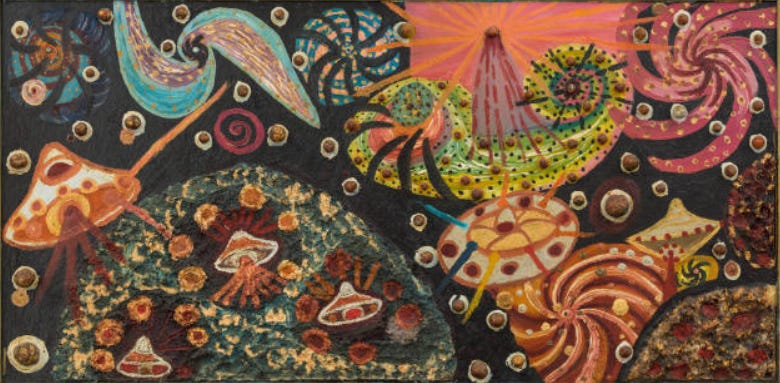
Ionel Talpazan, Mysterios Energie din Cosmos UFOs, 1992.
Jeffrey Kripal opened by naming the posture that would organize the day, and he did it with one word: listen. Not politeness, and not passive reception, but listening in the deeper sense, in which another person’s account is permitted to disturb the categories you brought to it.
Kripal is the J. Newton Rayzor Chair in Philosophy and Religious Thought at Rice, and the Center for the Impossible, which co-sponsored the day, is his. He has spent a career arguing that anomalous experience belongs inside the humanities rather than outside them, and much of the reason a symposium like this can now be held under a major research university’s name is that he spent twenty years making the room for it.
The question that keeps returning to him, he said, running through Mack and Grof and Vallée and everyone before them, is how to foreground, privilege, and think with the experiencer rather than about them. Then he gave the sentence that could have served as the symposium’s thesis.
If you foreground experience, everything changes.
That is not merely a philosophical commitment. It is a methodological one. It asks researchers to begin where the event is lived rather than where the institution is comfortable interpreting it. We are being asked to meet experiencers where they are.
And I want to press on why that matters, because it is easy to hear “foreground the experiencer” as a courtesy and miss that it is a claim about the nature of the thing being studied.
The default posture in this field treats the experiencer as a witness. Someone who was standing nearby when the interesting thing happened. On that model the person is essentially an instrument, a camera with an unreliable lens, and their value lies entirely in what can be extracted through them and about something else: the craft, the beings, the phenomenon proper. Everything else they bring, the fear, the missing time, the transformation, the ruined marriage, the decades of silence, is all considered noise to be filtered out on the way to the signal.
But that is not what the accounts describe. Over and over, what people report is not observation. It is participation. The event did not happen near them. It happened to them, and in many cases through them. Altered states. Telepathic exchange. Physical effects. A self that afterward will not fit back into its old shape. A witness watches from the roadside. These people are inside the thing they are describing.
Which means that stripping the experiencer out of the account in order to purify the data does not purify anything. It destroys the datum. The person is not the packaging around the phenomenon. The person is part of the phenomenon.
And this is where the methodological point becomes a clinical one, which is the argument of this entire essay in a single move. If the experiencer is a participant rather than a witness, then what happens to them afterward is not a side effect of the event. It is the event, still unfolding. Care stops being the kindness we extend once the science is finished. It becomes load-bearing.
And Kripal paired it with the epistemic humility that kept the day from collapsing into premature certainty:
“Nobody really knows what is going on”, he said, “and the people who claim otherwise are either fooling themselves or ignoring the evidence and the experiences alike”.
Nobody at this symposium was selling certainty. That, more than the subject matter, is what made it feel like scholarship.
Healthcare should recognize this posture instantly, because patients almost never arrive having pre-translated their lives into clinically useful language. They arrive with fragments, metaphors, and contradictions. They describe pain that refuses the scales, grief that has taken up residence in the body, experiences that sound implausible even to themselves in the telling. The work of care routinely begins before the work of explanation.
The Experiencers
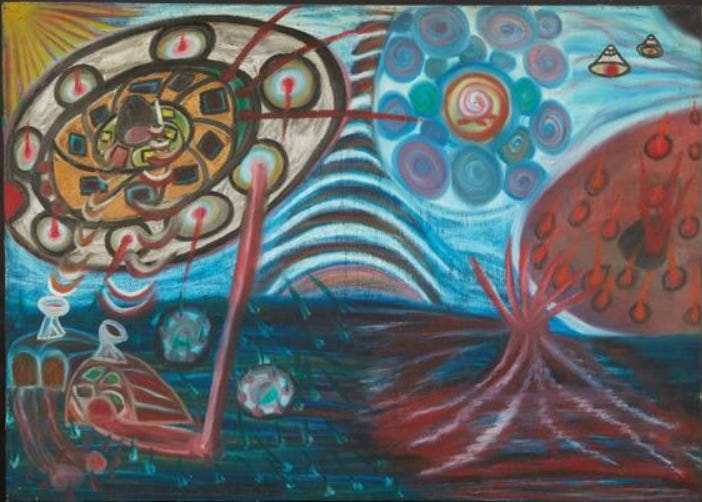
Ionel Talpazan, UFO Coming—Planet Energies, 1993.
Debra Jordan Kauble, known to many through Budd Hopkins’ Intruders as “Kathie Davis”, began with a sentence that should be taken seriously as method rather than modesty:
I’m not here today to try to convince anybody of anything.
That is not the posture of spectacle. That is testimony.
She has been a public figure in this story since the early 1980s, which means she has spent forty years being examined, doubted, defended, and discussed by people who were not there. She described a 1983 event witnessed by three other people, which left physical traces that persisted for years, and left her injured, frightened, and barely able to function.
She asked only that people listen with an open mind, and said she felt compelled to tell other experiencers that she saw them, heard them, and believed them, because that was what had mattered to her.
Silence was not an option for me. Silence hides the truth.
Long-time readers will know why that sentence stopped me. It is very close to the line I end almost everything I write with (The experience is yours. The silence is optional), and I did not expect to hear it back from the stage.
Her account contained real trauma: physical effects, fear, confusion, and the desperate wish that somebody would tell her the whole thing was ordinary and treatable. She remembered telling Hopkins and the psychiatrist he arranged for her to see that it would be fine if they concluded she was crazy, because they made pills for that, and she had two children depending on her.
And then she described what came afterward. Looking back, she said, it was almost like a death and a rebirth, a messy and painful one. Hopkins gave her more than an investigation. He gave her, in her words, a safety net: a place to be seen, heard, and accepted, a place to speak without judgment. As her body recovered and the fear loosened its grip, the experience itself changed. She became more focused, more curious, more awake to connection.
She did not romanticize any of it. She did not pretend the terror had been unreal. She simply refused to let trauma have the final word. On July 1, 1983, she said, she was not the person she had been on the morning of June 30.
That is a sentence healthcare should know how to hear.
Matthew Roberts, a former Naval intelligence analyst present aboard the USS Theodore Roosevelt during the collection of the Gimbal and Go Fast footage, approached the same terrain through initiation. Experiencers call these events “high strangeness”, he suggested, largely because they lack any more cohesive framework, and he reached for the humanities not as decoration but as a discipline capable of interpreting experience when the hard sciences cannot account for its meaning.
His argument was developmental. We already accept that a human life proceeds through stages, that infancy gives way to childhood and childhood to adolescence and adolescence to adulthood, and that each of those transitions is purchased with disorientation and paid off in a larger self. Roberts proposed that the phenomenon is doing something similar at the far end: modeling a stage of psychological development past ordinary adulthood, and inducing the experience required to reach it.
Initiation, in his account, involves the dismantling of an old perception of reality and the construction of a new one. Old values fall apart. New ones take shape. The process is frightening and destabilizing precisely because nothing is certain during the deconstruction.
Whether or not you accept his larger metaphysical claims, notice the shape of what he is describing: rupture, disorientation, deconstruction, reconstruction, value change, and the attempt to emerge into a larger life.
Readers of this newsletter will know that initiation is the frame I keep returning to as well. I have argued for a while now that anomalous experience behaves less like a mystery to be solved than an initiation to be metabolized, and watching a former Naval intelligence analyst arrive at the same word from an entirely different direction was one of the stranger pleasures of the day.
An initiation is not a private event. It is a social technology. Every culture that took transformation seriously built containers for it: a rite, an elder, a period of seclusion, and a community that knew what was happening to you and knew that you were not finished yet.
Anthropology has a word for the middle of that passage. Liminal, from the Latin for threshold. The initiate is no longer who they were and not yet who they will become, and every society that thought carefully about this understood that state to be both necessary and dangerous, and understood that the person standing in it has to be held.
We dismantled the containers. We did not stop producing the initiations.
So the person in the threshold no longer arrives at a ritual house. They arrive at an emergency department, or a primary care appointment, or a therapist’s intake form, and they arrive alone. And what a clinician sees, looking at someone mid-passage, is disorganization. Affect that will not track. Beliefs in flux. A self that will not sit still long enough to be assessed.
The system reaches for the only language it has, which is the language of pathology. And so it medicates the threshold as though the threshold were the disease.
The threshold is not the disease. The threshold is where transformation happens, when it is permitted to. Healthcare meets this structure constantly and files it under other names. The experiencer literature may be strange. The human pattern is not.
Andrea Oddo and Charles Holt sharpened this through their work with experiencer communities, including the online spaces where people arrive frightened, isolated, and unsure whether it is safe to speak at all. Oddo is the John Mack Institute's executive director and Holt its communications director, and both have spent years moderating the r/Experiencers community, which is one of the largest rooms in the world where people bring an experience like this for the first time.
They call their approach the Middle Path, and the commitment behind the name is deliberate: they will not hand anyone a worldview. Not a nuts-and-bolts one, not a spiritual one, not a psychiatric one. The person is helped to hold their own experience rather than handed someone else’s interpretation of it.
They have talked with tens of thousands of people at every stage of coming to terms with impossible things, and their description of ontological shock was the plainest of the day. When a person’s worldview can no longer build a coherent narrative around what happened to them, they said, it is not like getting an unpleasant surprise. It is like the floor gives out.
Then comes the social risk. Imagine standing up before the pack, they said, to announce that the impossible happened to you.
Their practical insight was just as important. Many people arriving in these spaces are not looking for answers at all. They just want to be heard. Someone has taken what may be the largest social risk of their life to describe the most private thing that has ever happened to them, and what they are asking for, at least at first, may be as simple as: I hear you. You are not alone. I believe you.
Their community rule distinguishes inquiry from cruelty with real elegance. Skepticism is welcome. Ridicule is not. Most of what passes for skepticism in these spaces, they argued, is dogmatic ridicule wearing a lab coat.
They care about the people, they said. Not the national security story, not the question of who or what the intelligence turns out to be. They are not trying to solve the mystery. They are trying to help people through it.
When formal systems cannot receive people, informal systems grow in the gap. Peer support becomes triage. A subreddit becomes a waiting room. Strangers become the first line of care because the official places of care feel too dangerous to approach.
That does not mean peer communities can or should replace healthcare. It means healthcare ought to notice when people build parallel systems to meet needs it has failed to recognize.
Discernment
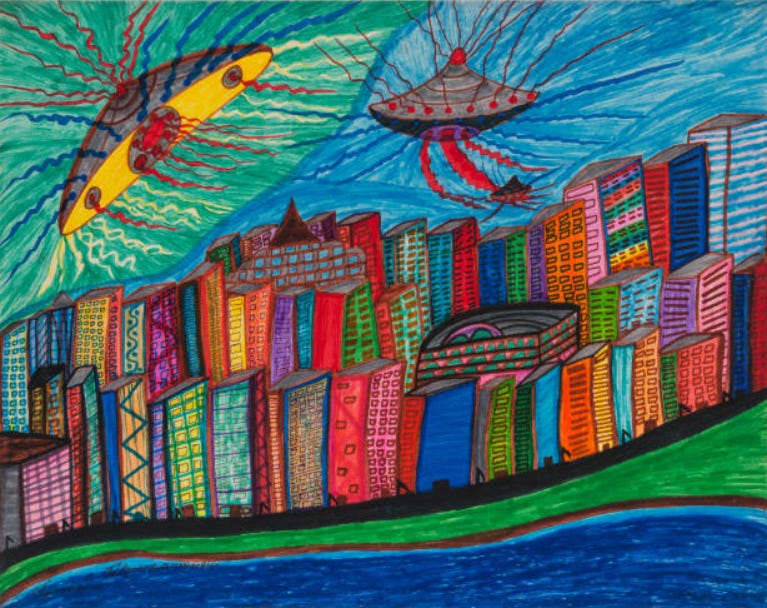
Ionel Talpazan, Untitled, 1994.
Simon Bresler’s presentation made that absence clinically impossible to ignore, and it may have been the symposium’s most important contribution, because it demonstrated that serious care for experiencers does not require abandoning discernment. It requires deepening it.
Bresler is a licensed clinical social worker, a certified group psychotherapist, and clinical director of the John Mack Institute. He also spent years in psychiatric settings, including a hospital psychiatric unit, and he made clear that he knows exactly what severe mental illness looks like. That is what gave the talk its authority.
Good clinicians learn early that uncertainty is not a failure of medicine but one of its permanent conditions. Diagnoses evolve. New information revises old conclusions. Patients understand their own experiences imperfectly, because profound experience rarely arrives pre-organized into a coherent narrative. Clinical maturity does not consist of eliminating uncertainty. It consists of learning to remain thoughtful inside it.
Modern culture tends to imagine only two responses to uncertainty: suspend judgment until perfect evidence arrives, or rush toward certainty because the not-knowing is unbearable. Healthcare has long practiced a third way. A physician can investigate while remaining compassionate. A psychiatrist can assess without dismissing. A nurse can acknowledge an experience without deciding prematurely what it ultimately means.
Bresler’s distinction between unusual content and psychiatric disorder is the heart of it. The clinical question is not whether a story sounds strange, because many true things sound strange the first time they are spoken aloud. The clinical question is how the person is functioning, how the account is organized, whether there is flexibility or rigidity, whether distress is escalating, whether reality testing is intact, and whether the experience has isolated the person or opened them into a wider life.
He walked through the actual markers, which is what made it clinical rather than rhetorical. In psychosis you see disorganized thought and speech, delusions held rigidly and without flexibility, and marked functional impairment: trouble getting dressed, showered, fed, employed. What he sees in experiencers is largely the reverse. The narrative may be extraordinary, but the telling is coherent. Thought process is organized. Reality testing is intact. Functioning is preserved. They are going to work, cooking meals, raising their children.
What they bring instead is ambivalence. He quoted the way it actually sounds in his office: I don’t know, Simon. This sounds crazy. Maybe it was a dream, but it didn’t feel like a dream. Is this even possible? That doubt is diagnostically significant, and it is precisely what a fixed delusion is not. A person locked inside a delusional system does not agonize over whether they might be wrong.
And then the after-effects, which he noted appear in no psychotic episode anywhere: expanded consciousness, altered spiritual beliefs, increased ecological concern, a stronger sense of purpose, heightened intuition, changed values, a felt sense of connection or oneness. Destabilizing, certainly. Pathological, no. He was careful to add that pathology does occur in experiencers too, and that insomnia, hypervigilance, depression, anxiety, and genuine trauma symptoms all deserve treatment when they appear.
He put the duty cleanly, and I have not stopped thinking about the sentence:
We don’t want to miss if someone is suffering with a mental health issue. We also don’t want to diagnose them with one they don’t have.
That is the whole ethic. Not credulity, not dismissal, but discernment.
He also defended Mack’s term ontological shock, not as jargon but as a phenomenon he watches happen to people. It is not simply fear or anxiety, he said. It is a disturbance in the bedrock assumptions that previously organized reality, in which something that had been outside the realm of possibility suddenly appears possible but incomprehensible. The person is left with questions that are not factual but existential. What is real now? What else was I wrong about? What does this mean about consciousness, about death, about my own identity?
And then the one with teeth: who can I trust now?
When reality is shaken, Bresler observed, people do not only question the event. They question the authorities who gave them their picture of reality in the first place. Parents, churches, scientists, governments, doctors. And a person in that condition is at risk in a way most clinicians never think to assess for, because when the old certainty collapses, a new certainty can rush in to fill the vacuum. The person may flee one rigid worldview straight into another. The healing task, he said, is to help the experiencer tolerate mystery without collapsing into dogma, despair, fear, or grandiosity.
His five markers of integration, offered as a non-linear map rather than a staircase, were:
Shock and Destabilization
Containment
Meaning-Making
Worldview Expansion
Reintegration.
Containment may be the load-bearing one. The experiencer needs a relational space where the experience can be spoken without ridicule or premature interpretation, a space that communicates: I am taking seriously what has happened to you. Your thoughts and feelings and observations are welcome here. I want to hear more.
All of which can be offered without making a single claim about what the event ultimately was.
The Absence in the Literature
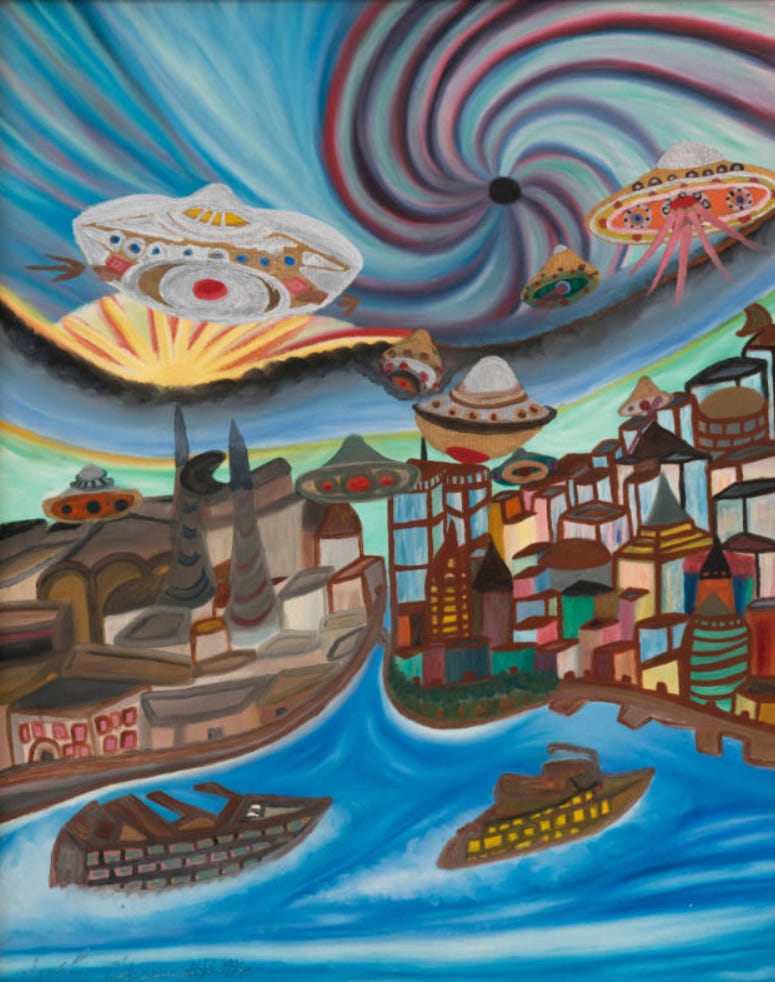
Ionel Talpazan, Untitled, 1994.
Douwe Bosga’s presentation made clear why listening alone is not enough.
Bosga is a parapsychologist at the Institute of Parapsychology in Baarn, in the Netherlands, and he has been studying this since 1977, when he spent a year at the Center for UFO Studies with J. Allen Hynek. He presented preliminary results from a PRISMA-protocol scoping review of the scientific literature on the alien abduction experience, searching Medline, EMBASE, PsycInfo, and Web of Science from inception through August 2025. Among his co-authors is Miranda Olff, professor of psychotrauma at Amsterdam UMC and the ARQ National Psychotrauma Centre, and editor-in-chief of the European Journal of Psychotraumatology.
Consider that collaboration for a moment. A parapsychologist and the editor of the field’s flagship trauma journal, running the single most conventional instrument in evidence-based medicine, the same protocol you would use to review statin trials, on alien abduction.
That is what the taboo breaking actually looks like.
Nearly fifty years into the work, he did something that takes a particular kind of nerve. He turned the most conventional instrument in evidence-based medicine on his own field’s central subject, knowing perfectly well that the results might not flatter it.
The findings deserve more attention than they received. Out of 11,218 records, 52 articles met inclusion. Overall study quality was low. Definitions, instruments, and research designs were wildly heterogeneous. More than forty distinct features of the experience appeared across the literature. The explanatory frameworks ran the entire range, from fantasy proneness and false memory through sleep paralysis and hypnagogic hallucination to folklore and non-human intelligence, and not one of them was sufficiently supported by the evidence.
And the papers did not indicate a typical psychological profile of the experiencers. Eighty years of literature, and the pathologizing hypothesis does not produce a profile.
Unlike most medical subjects, the alien abduction experience has no established MeSH (Medical Subject Headings) terms. Medical Subject Headings are part of how medical science indexes what it knows. No shared indexing language means the literature is harder to search, harder to compare, harder to review, and harder to build on. His team had to invent a search strategy from scratch.
His recommendation was direct. The field needs stronger scientific rigor, beginning with a shared definition of the alien abduction experience and expert-based guidelines for case studies, and “shared” has to include experiencers alongside researchers and clinicians.
Read that as a philosopher and it sounds like a lament.
Read it as somebody who works in public health informatics (like myself) and it is a work order.
A shared definition is not a wish. It is a deliverable. It is called a case definition, and it is among the first things you build, before surveillance, before epidemiology, before you can count anything or study anything or fund anything or responsibly compare anything at all. Standardized instruments and case guidelines are not exotic. They are infrastructure, and they are the ordinary machinery by which a scattered set of observations becomes a body of knowledge.
I hit the same wall from the other side, and I have written about it before. MeSH is the vocabulary research uses to index what it knows. ICD-10 is the vocabulary the medical clinic uses to index what it sees. They are the same kind of object, a controlled list of what a system is prepared to admit exists, and the clinical list has precisely the same hole in it.
There is an ICD-10 code for being struck by lightning. There is a code, and I promise I am not making this up, for problems in your relationship with your in-laws. There is no code for a lucid, functioning adult whose model of reality has come apart. The closest available is Z71.9, counseling, unspecified, which is the code you reach for when nothing in the entire diagnostic system fits, and which most insurers will not reimburse, because Z-codes are classified as non-medical.
Sit with what that means. Even the clinician who wants to help, who believes the patient, who has read the literature and knows exactly what she is looking at, cannot bill for the visit. In American healthcare that is not a technicality. It is the whole game. If it cannot be coded, it cannot be billed. If it cannot be billed, it does not get done. And if it does not get done, it never becomes the evidence that would have justified doing it.
Bosga’s problem and my problem are the same problem at two different altitudes. His stops knowledge from accumulating. Mine stops care from being delivered. And each one guarantees the other.
Bosga’s real finding is not that the evidence is thin. It is that the evidence cannot accumulate. Without shared definitions, case standards, and indexing structures, observations stay scattered across disciplines that cannot hear each other. Researchers speak one language, clinicians another, experiencers another, philosophers another. Each contributes something essential. Each risks isolation. And what disappears in the gaps between them is not merely conceptual tidiness. It is institutional memory.
Transformed Into What?
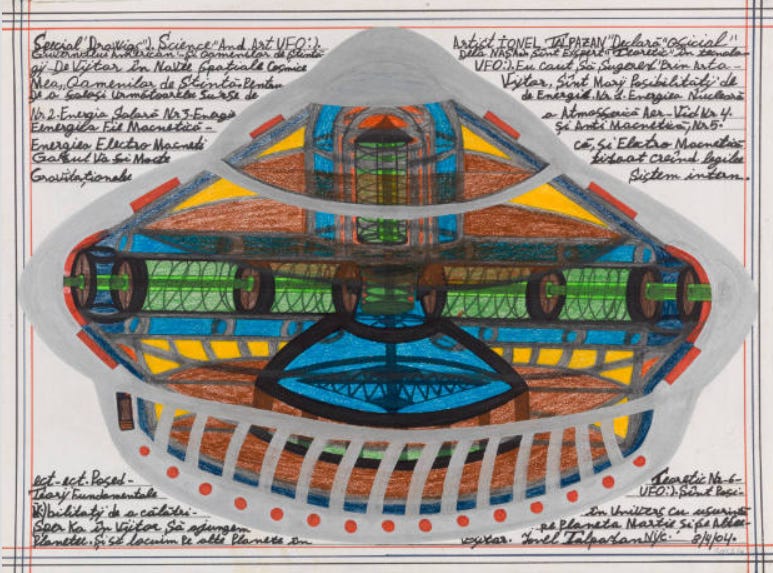
Ionel Talpazan, Untitled, 2004.
Beth Glick returned the conversation to the human life that all of this infrastructure is supposed to serve, and she asked what I think is the most important question anyone in this field is currently asking.
Glick is a doctoral researcher at the California Institute for Human Science who came to this work from twenty years in human rights and atrocity prevention, which is to say from a career spent studying what happens to people after the unthinkable. She collaborates with the Institute of Noetic Sciences, the University of Virginia’s Division of Perceptual Studies, and the Worldwide Initiative for Super Experiencer Research, and she co-leads The Synapse.
Her talk was titled Transformed Into What? Measuring Identity and Action After Exceptional Experience. The field, she noted, keeps asking whether these experiences are real and how they possibly could be, and keeps losing the person at the center: whether and how their life actually changes. Her instrument, the Exceptional Experience Integration and Impact Measure, or EXIM, examines how cumulative exceptional experiences reorganize a life across identity, worldview, relationships, and behavior. Not whether someone reports having been changed, which is easy to measure and nearly meaningless, but whether the change is integrated: whether those four domains moved together, or came apart.
Her emphasis on the cumulative matters. Most people do not have one anomalous event. A single UAP encounter may arrive braided with altered states, sensed presence, bodily effects, psychic phenomena, and contact-like communication. Glick calls this multiplexity, and it means these experiences are frequently layered and cross-domain rather than discrete. Isolate one encounter from the pattern and you may have distorted the picture before you begin.
But the question at the center of her work is the one the romantic version of this subject refuses to look at. Yes, these encounters catalyze interconnectedness, ecological concern, and expanded moral consideration. Kauble’s flourishing is real, and it is not rare.
But these experiences can also produce ego inflation, grandiosity, and the hardening of belief into dogma. The prophet who was, a year ago, just a person.
Transformed, yes. But into what? And what moderates the difference?
Glick named a bias that reaches far beyond this field. Most of our instruments are built to detect growth rather than to ask the direction of change. They can register that someone says they changed. They cannot always tell whether identity, worldview, relationships, and behavior moved together or came apart.
In Who Catches Us I argued that there are two ways to fail an ontological rupture, and that we only ever talk about one of them. The first is coming apart: fragmenting under the weight, which is what resilience is designed to prevent. The second failure is invisible to resilience, and experiencers know it in their bones. It is sealing back over. Refiling the impossible thing into the old system so neatly that you never have to change.
Grandiosity is not the opposite of that second failure. It is a species of it. A new certainty rushed in to fill the space, so the person never has to live inside the open question. Bresler described the same movement from the clinical side: fleeing from the unknown into the unknown.
Metanoia is the narrow path between the two. Neither collapsing into the experience nor slamming the door on it, but learning to inhabit the self the experience left behind.
Which suggests that the moderator Glick’s instrument is reaching for may not be a trait at all. Not fantasy-proneness, not absorption, not any stable feature of the person who walked into the encounter. It may be a capacity, and capacities can be supported or starved. It may depend less on who you were beforehand than on what met you afterward.
Whether anyone believed you. Whether you were alone. Whether the first professional you told reached for containment, or reached for a diagnosis.
Those are health variables. They are measurable. They are modifiable. And at present they are nobody’s job.
The Gap in the Room
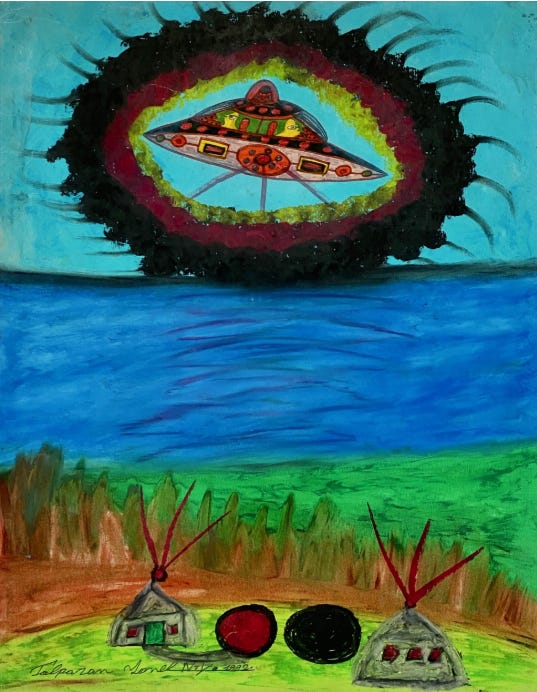
Ionel Talpazan, Untitled, 1992.
The final session took the problem to its edge.
Michael Bohlander, who holds the Chair in Global Law and SETI Policy at Durham and has served as an international judge in Cambodia and Kosovo, approached it through law and evidence. He was explicit about his lens: when assessing testimony, he uses a judicial one. This is a man who has spent a career deciding what to do when the evidence is imperfect and a human life turns on the answer, which is a rarer and more relevant qualification in this conversation than most of the credentials usually brought to it.
He has also chosen to proceed as though contact experiences can be real in an actual physical sense rather than a mythological one, and that choice opens hard questions about consent, force, harm, and responsibility. Take the accounts at face value, apply human law, and the picture is stark. Confinement against one’s will is false imprisonment. Unconsented physical procedures are battery, and in some accounts assault. Motive is legally irrelevant, and so is any claim of superior knowledge or benevolent purpose. Prior familiarity with our norms is not required for a wrong to be a wrong.
Kimberly Engels, associate professor of philosophy at Molloy and research director of the John Mack Institute, approached it from phenomenology, and took the argument apart from underneath. Her talk, The Limitations of Anthropocentric Ethics: Navigating Morality Amidst Epistemic Gaps, asked how human ethical categories can function across a divide we do not understand. Our moral vocabulary was built by humans, for relations among humans, and it assumes a rough parity of knowledge between the parties.
If the intelligence is differently situated in time, if it possesses insight into the nature and purpose of the contact that we lack, then conventional appeals to consent, autonomy, and harm require re-examination. Not abandonment. Re-examination.
Her new book, Contact and Multidimensional Subjectivity, develops the same move at length, asking what becomes visible when contact accounts are no longer read through the lens of delusion or the lens of threat, but are allowed to appear on their own terms. It is a hard argument to make in a room that includes people who were hurt, and she never once used the epistemic gap as a reason to look away from the harm.
The tension between the two is not a weakness of the field. It is the frontier. One insists that harm must not be dissolved into mystery. The other insists that mystery must not be prematurely collapsed into familiar categories of harm. And the tension matters clinically, because the person in front of you may be injured, or transformed, or both, and you will not know which, and you have to respond anyway.
I want to stay with Engels a little longer, because her method, not just her conclusion, is the closest thing at that symposium to what I am trying to do.
Her project asks what becomes visible when contact accounts are no longer filtered through the lens of delusion or the lens of threat, but are permitted to appear on their own terms: taken seriously as sites of inquiry rather than reduced to whatever explanatory framework we walked in holding. That is not credulity. It is discipline. It is the oldest move in phenomenology, and it has a second life nobody at the symposium mentioned.
It is also a description of good clinical practice.
Receive the account as given. Do not reduce it to the nearest familiar category before you have understood what you are looking at. Let the phenomenon be what it is long enough to see it clearly. Phenomenology, from where I sit, is bedside manner with a philosophy degree.
Because here is what struck me, watching a philosopher describe an epistemic gap between humans and something else: There is a second epistemic gap, and it opens inside the exam room.
Not between the experiencer and the phenomenon. Between the experiencer and the institution receiving the story. A person arrives holding an event that exceeds the conceptual grasp of the system meant to help her, and the system, having no category, does what systems do. It reduces the event to the nearest thing it already recognizes.
The account becomes hallucination. The distress becomes anxiety. The transformation becomes instability. The mystery becomes a symptom.
The reduction feels like rigor. It is the opposite of rigor. And sometimes, once it happens, the person never speaks of it again.
Brenda Denzler, whose The Lure of the Edge remains the definitive sociology of this subject and has aged better than almost anything else written about it, gave the session its historical and religious depth as respondent, and brought her own sympathy for people traumatized by these experiences, rooted partly in early medical trauma of her own. These beings, she said, echoing Kauble, need not be reduced to gods or angels or demons. They just are, and apparently we have some kind of relationship with them, and the question is how that relationship gets managed.
That is exactly the threshold problem, and it runs straight through the clinic. The same event can be received as intrusion, opportunity, trauma, initiation, wound, or calling. Those interpretations have consequences. The name we give an experience can determine what kind of life a person believes is available to them afterward.
What Archives Remember, and What They Reveal
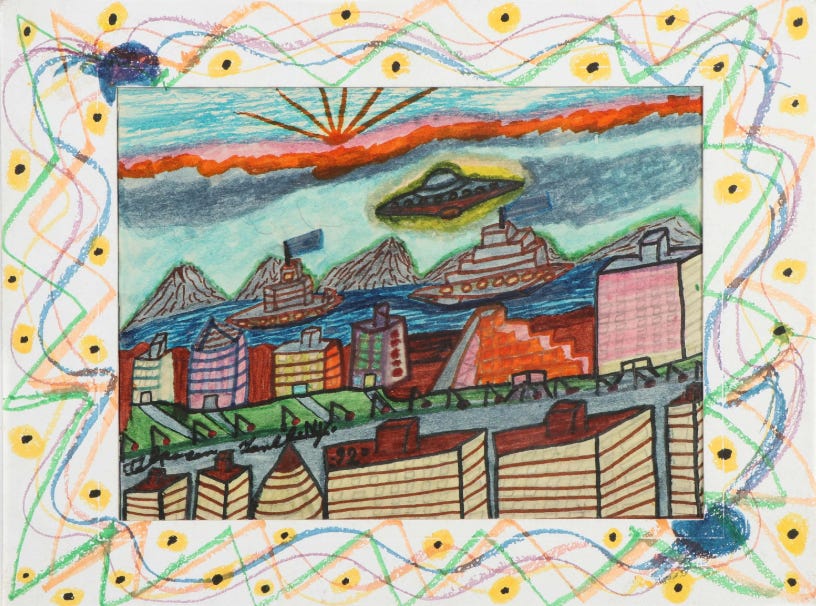
Ionel Talpazan, Untitled, Unknown.
Karin Austin’s work made the stakes of that silence concrete.
Austin is managing director of the John Mack Institute and the Center for the Impossible, a former participant in Mack’s research, and later his personal assistant. She speaks from several positions at once: experiencer, researcher, and steward of memory. She described the metadata project now underway across major collections, including the Mack and Whitley Strieber materials, work she is leading in partnership with Rice’s Amanda Focke. Thousands of documents and tens of thousands of pages are moving through transcription, digital correction, anonymization, and phenomenological bracketing, guided by the framework Engels has built. It is enormous, unglamorous, largely invisible labor, and it is the kind of work that determines what a field will be able to know about itself in fifty years.
She also said the thing nobody else quite said out loud: experiencers remain marginalized even inside the UAP community. They are the source of the data and the last people invited to interpret it.
Archives matter because they hold what institutions failed to hold. Accounts that were dismissed, hidden, privatized, and scattered begin, through this kind of labor, to acquire collective presence. They become harder to treat as isolated oddities. They begin to show patterns.
But archives also reveal absence. Who felt safe enough to speak? Who knew where to bring the story? Whose account was preserved, and whose vanished because no institution knew how to receive it?
The symposium was honest about its own absences, too. In the closing discussion, Engels acknowledged that the day had been presented from a largely white, Euro-American perspective. Dr. Tim Murithi had been scheduled to speak on encounters in Africa and had to withdraw. Engels named the need to bring Indigenous scholars, elders, and other marginalized communities more robustly into the work, invoking the principle nothing about us without us.
That correction matters, and not only as good manners. A field that proposes to study humanity’s encounter with the non-human cannot be built from a single cultural vantage point. Recognition is never neutral. What one culture treats as pathology, another understands as spiritual experience. What one institution records as disorder, another community understands as initiation, calling, grief, warning, or contact.
Healthcare cannot navigate those differences responsibly by abandoning discernment. But neither can it pretend its categories descend from nowhere. Institutions have worldviews too. Hospitals have them. Diagnostic manuals have them. Electronic health records have them. Every system that sorts human experience must decide, explicitly or not, what kinds of things are possible, what kinds of suffering are legitimate, and what kinds of stories can be preserved without distortion.
The Bedside
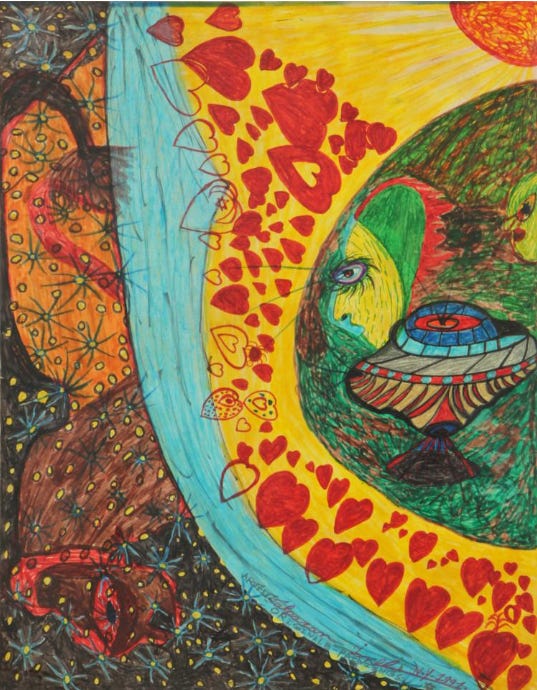
Ionel Talpazan, Untitled, 1995.
Long before I had language for any of this, I met it at a bedside.
Years ago, working as a bedside nurse, I cared for a dying woman who told me, quietly, that her sister had come to see her. Her sister, I had been told, had been dead for years.
The room did not become dramatic. There was no argument to be had. She was not asking me to adjudicate the metaphysics of what she had seen, and she was not trying to persuade me of anything. She was telling me something that had become real inside the world she was now living in.
I remember listening. I remember the calmness of her voice. I remember understanding, without having to reason my way to it, that my responsibility in that moment did not depend on whether I could explain what she had seen. I was responsible for the woman in front of me, and everything else was secondary.
Patients describe pain no instrument can locate. Families notice changes before the scans confirm them. People make meaning out of illness through religion, memory, metaphor, culture, and dreams that medicine can neither verify nor honestly dismiss.
None of that absolves clinicians of the duty to think carefully. Discernment matters. Assessment matters. Evidence matters. But care has never waited for perfect explanatory certainty, and it cannot start now.
What I could not do that night was write any of it down. The chart offered me a menu, and every option on it was a way of saying that the woman in front of me was malfunctioning.
The Second Taboo
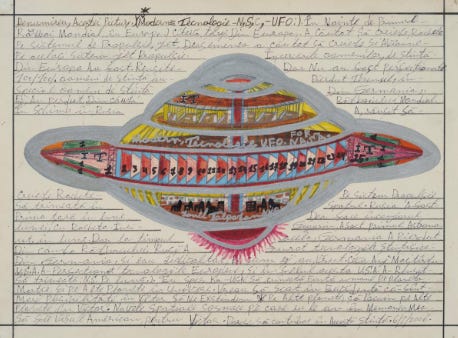
Ionel Talpazan, Modern Technology UFO for N.A.S.A., 2006.
Look at what assembled itself over those five hours, and listen to what the people in it were asking for.
Douwe Bosga asked, in as many words, for a shared case definition and expert-based guidelines for case studies. Beth Glick is building an instrument because the field has no reliable way to measure what happens to a person afterward. Simon Bresler laid out a five-stage model of integration that exists, so far, in a private practice and nowhere else. Andrea Oddo and Charles Holt said plainly that their peer-support work exists because of the absence of accessible, stigma-free clinical care. Karin Austin is building an archive because these observations were never held anywhere they could accumulate. Kimberly Engels, Michael Bohlander, and Brenda Denzler were asking a different order of question altogether, and the field will not survive without them either.
Nobody in that room had to be told what was missing. They said it out loud, each from their own corner, and I do not think any of them said it as an appeal to healthcare. They said it because it was true.
But I want to name what I heard, sitting where I sit.
Case definitions. Standardized instruments. Care pathways. Triage. Documentation that does not distort what it records. Some way for scattered observations to accumulate into evidence instead of evaporating.
None of those are exotic requests. They are the ordinary furniture of health services, and there is an entire workforce trained to build them. Nurses. Informaticists. Epidemiologists. Public health researchers. People who spend their working lives turning what happens to human beings into something a system can see and act on. We are not rare, and we are not remarkable, and almost none of us has ever been told that any of this concerns us.
That is the gap. Not a shortage of insight, and certainly not a shortage of courage, both of which were in abundant supply that day. A missing trade.
Years ago I sat with a dying woman who saw her dead sister at the foot of her bed, and I charted a symptom. It has taken me most of a career to understand that the chart was never a neutral instrument. The people at that symposium have been doing this work, at real cost, for decades.
The John Mack Institute called the day Breaking the Taboo, and the title was exactly right.
The academy is finally breaking its own.
Healthcare has not yet admitted that it has one.
For months before the symposium, I had been trying to name the dimension of health that is affected when a person’s relationship to reality is wounded, destabilized, expanded, or remade. Trauma names part of it. Spiritual distress comes closer. Existential crisis helps. Ontological shock, Mack’s own term, names the blow beautifully.
None of them names the thing the blow lands on.
I have come to call it ontological health. What the symposium gave me was the evidence that I am not the only one circling it, and the conviction that the language is now overdue.
If experiencers are not merely witnesses to anomalous events but human beings living through profound disruptions of meaning, identity, trust, and belonging, then their care cannot remain outsourced to private courage, sympathetic therapists, Reddit threads, and the accidental good luck of meeting a clinician who happens to know how to listen.
That is not a system. That is luck.
In Part II, I will make the case: what ontological health is, how it breaks, what the evidence already shows, and what a health system that took it seriously would actually have to build. A longer journal paper follows later this year (details will be posted on my SubStack).
The academy is learning how to listen.
The question is whether healthcare will.
Part II: Ontological Health: A Proposal should be out in about a week.
The symposium recording is here.
If this resonated, you’d likely find your people in the Discord: a growing community for the stranger end of the phenomena, the philosophy under it, and the experiencers living it. We go deeper in real time. JOIN HERE.
New to The Maze to Metanoia? SUBSCRIBE to follow along, and feel free to SHARE this article as well:
The experience is yours. The silence is optional.
Another extremely well done dissection of an issue that we are all at some level aware of, but no one before you has really tied it all together as you do so well. I know that I mentioned it on Discord that I am a fully trained psychedelic facilitator who, no doubt, was drawn to this field by a deep interest in shamanism and ancient Mediterranean religions. I believe that all of these things are different roads to the same phenomenon. It would be my dream to put together a practice with a medical professional where we are doing just what you've described in this article. Thank you, Meredith.
Thank you so much for this wonderful summary of the symposium, which I unfortunately wasn’t able to attend.
Your writing is inspiring to me as an experiencer. It makes me believe we can chart a way forward that allows integration and positive expansion. There are so many of us experiencers! Surely , at a global scale, the initiation can serve to transform the state of humanity. I believe.
And, the model you are beginning to formulate about how the health care system can provide care for those experiencing ontological shock is forward thinking. Looking forward to part 2.