
The Permission Structure
What yesterday’s press conference on the Capitol steps was actually about and why it wasn’t the files.

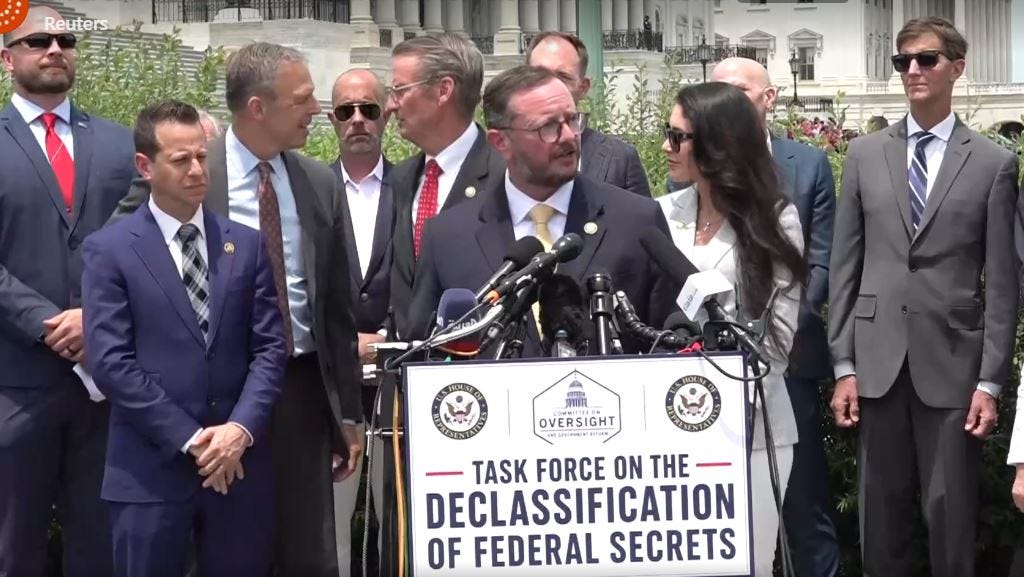
On June 9, on the steps of the US Capitol, David Grusch stood with Representatives Luna, Burchett, Burlison, and Moskowitz, Leslie Kean and James Fox hosting, and asked the President of the United States to release what eight decades of classification have buried.
And let me not undersell what was said out loud, on the record, in front of cameras, from a podium at the United States Capitol. Grusch, asked how many forms of nonhuman intelligence the government is aware of, answered that it’s “a continuum from corporeal bipedal type life” to what he’d consider “sentient plasma life”.
He declined to comment on the content of Immaculate Constellation, but reiterated that it was a National Security Council program, with its secrecy infrastructure created by an Eisenhower executive order in 1954.
Leslie Kean, citing a congressional staffer of decades who stood behind her, said senators including Marco Rubio were briefed in classified settings about recovered nonhuman bodies and called on the president to declassify evidence of “recovered advanced nonhuman biological entities”. James Fox laid out the 1996 Varginha case: dozens of firsthand witnesses, living nonhuman beings allegedly flown out of Brazil to the United States, and Brazil’s former Minister of Defense, Aldo Rebelo, now publicly confirming the incident occurred. Burlison described MQ-9 footage of a UAP off the coast of Yemen reaching his office through what he called “a Tom Clancy style dead drop”, and relayed accounts, from people he said are in positions to know, that presidents themselves have been kept on a need-to-know basis by career officials who view them as temporary help. “That is not classification”, he said. “That’s a constitutional crisis”.
Any one of those statements would have been unthinkable from elected officials five years ago. Each will get its share of headlines, and each deserves scrutiny as these remain claims, not yet evidence. But I want to suggest that even the wildest quotes were not the real story. The headlines are aimed at the wrong altitude. Pay attention to what the people on those steps were actually asking for, and a different event emerges.
This was a press conference about who is legally permitted to speak.
The statute in the room
Buried in the Q&A, almost as an aside, Congresswoman Luna said the thing that should have led every story: a meeting is set with the White House, the White House is “going to play ball”, and for those with knowledge of the locations of craft or materials, permanent immunity is being considered; So that, in her words, people can’t be hit with a violation of the Espionage Act. In her opening remarks she credited Stephen Miller’s office by name, and named the ask plainly: temporary or permanent immunity for whistleblowers who divulge locations of craft and advanced technologies.
The Espionage Act is a federal law that criminalizes the unauthorized disclosure of national defense information. It is over a century old. It was written for a world of trench warfare and telegraph intercepts, and it has spent the last several decades doing quieter work: standing behind every nondisclosure agreement, every security clearance, every classified read-in, as the final answer to the question what happens to me if I talk?
Grusch knows the answer personally. Yesterday he described learning, through his ongoing federal litigation, that the Air Force worked with an external agency to seek an investigation of him for alleged unauthorized disclosures punishable under the Espionage Act after he testified before Congress in 2023. This is the man whose sworn testimony cracked this subject open. The reward for what he calls his continued service to his constitutional oath was a federal investigation into whether his speech was a crime. As he put it: this should concern every member of Congress, regardless of party.
So when Luna seeks immunity for those who come forward, and when Burlison stands at the same podium and calls on the President to waive nondisclosure agreements outright (“use the authority you have”) they are not asking for documents. They are asking for something stranger and more fundamental. They are asking the state to dismantle the legal machinery that keeps its own people silent. Burlison said the quiet part with unusual clarity. To those who insist whistleblowers should have used proper channels, he answered: to hell with the safe way, “the safe way protects the system”.
The continuum
I have spent this newsletter’s entire life writing about the architecture of silence: about what it costs to carry something real without a room to put it in. My people are the pilot who filed no report. The nurse who saw something at a bedside and charted around it. The witness who drove home in the dark and never said a word, not because the experience was uncertain but because the world offered no place to set it down that didn’t cost them something.
What yesterday made plain is that the government’s own people live on the same continuum. The intelligence officer under NDA and the experiencer under stigma are carrying the same kind of weight; the difference is only in what enforces it. For one, it’s the fear of being thought unwell, unserious, unreliable. For the other, it’s a statute with prison terms attached. One silence is cultural. The other is codified. They are the personal and institutional faces of a single architecture, and that architecture is eighty years old. Burchett named it plainly from the podium: an eight-decade coverup.
This is why James Fox’s line from the steps might be the truest sentence spoken yesterday: reality should not be classified.
Not “these documents should be released”. Not “this program should be acknowledge”. Reality itself. The texture of what is actually happening in our skies and our oceans and, if Grusch and others are right, in our government’s custody has been placed behind a clearance. And everyone who has brushed against that reality without authorization, whether in a SCIF or on a back road at 2 a.m., has been left holding something they were never given permission to know.
That sentiment isn’t confined to the filmmakers and the podium. Rear Admiral Tim Gallaudet, US Navy (ret.), named from the podium yesterday by Representative Burlison as one of the whistleblowers whose careers were upended for coming forward told me:
“The call for UAP whistleblower immunity by members of Congress is the right thing to do. The American people have a right to know the truth, and the nature of reality should not be classified”.
Gallaudet isn't observing this fight from the outside. He's one of the people the immunity would protect. That makes his endorsement something more than commentary. It's a man still inside the silence, telling you the door should open.
The people already know they’re carrying it
Here is the detail from yesterday that moved me most, and it didn’t come from a whistleblower. It came from Jared Moskowitz, Democrat of Florida, who said that his constituents ask him about this more than any other issue.
More than any other issue. Not inflation, not healthcare, not the things we are told ordinary Americans care about. The official position for eight decades has been that there is nothing here, and yet the people of one Florida congressional district will not stop asking their representative about it. The silence, it turns out, was never the public’s. The public has been ready. The silence is official, structural, enforced from above and the people underneath it have been carrying the question all along, the way my readers carry their experiences: privately, persistently, without a framework, waiting for permission that never comes.
Leslie Kean named what’s at stake in that waiting. The knowledge that other, higher-order intelligent life exists would be, she said, may be the most consequential scientific discovery in human history. That is not a policy point. That is a metanoia point. The kind of knowing that doesn’t add to your picture of the world but replaces it. And it is being held, allegedly, by people who face federal prosecution for sharing it, on behalf of a public that asks about it more than anything else.
When one voice breaks, others come loose
There was an international note in yesterday’s event that deserves more attention than it will get. Fox cited Aldo Rebelo, Brazil's former Minister of Defense, who has confirmed: if the US discloses, Brazil could do the same.
Silence, it seems, is reciprocal at the level of nations too. Every government holding something is watching every other government hold it, and no one wants to be first. It is the geopolitical version of a dynamic every experiencer knows intimately. Nobody speaks until somebody speaks. And then, once one person says it out loud, the room changes, and suddenly everyone has been waiting years for exactly this moment. Burlison closed with a challenge to any foreign country, and to anyone in the US intelligence community, to release what they hold. He understands the mechanism. The first voice is the most expensive one. Every voice after it is a little cheaper.
What I’m watching
A meeting with the White House is not a signed grant of immunity. A grant of immunity, if it comes, is not the same as files on a table. Grusch was blunt yesterday that the DIA is obstructing Luna’s Task Force even now, and the gap between a press conference and a policy is where disclosure efforts have historically gone to die.
But I notice what has changed in the asking. In 2023, the ask was believe this man’s testimony. Yesterday, the ask was change the legal consequences of testifying. That is a profound shift from pleading for credibility to engineering permission. Grusch put it in terms my readers will recognize, even if he was speaking about budgets: there cannot be one standard for the American people and another for those who hide behind secrecy. The people who built the silence have always exempted themselves from its costs. What was proposed yesterday, in concrete legal terms, is ending that exemption from the other direction. Not by punishing the silent, but by making speech survivable.
That is what a presidential grant of whistleblower immunity would actually be. Not disclosure of files. Disclosure of voices. A room, finally, with a door in it.
For eighty years, the question asked of everyone who saw something (in uniform or out of it, with a clearance or with nothing but their own eyes) has been can you prove it? Yesterday, on the steps of the Capitol, the question quietly changed.
The new question is what would you say, if saying it were safe?
I suspect a great many people, in the intelligence community and in the quiet of ordinary lives, have spent decades rehearsing their answer.
This is exactly what I took away from the meeting as well.
They have been amplifying the need to protect whistleblowers. We need this not only for this topic, but other Gov whistleblowers for other corruption within. They need protection..
It should be an easy ask, but they haven’t been able to get it.
Also I was very happy Leslie put the focus more on the NHI. No one has Ever had the right to keep the knowledge of other intelligent life from us. That is an abuse of power and classification. How do you think they got away with Ep stein for so long.. These are tied together.
If people would watch the last 5 minutes of James Fox “Moment of contact”, the one he just released. The Neurosurgeon speaking at the diner with James. He describes his interaction with the Being, and it was beautiful. You have to wonder, what happened to that Being after US took custody.
UAP disclosure I think has the answers to many other questions we have right now.
I think it’s part of all the chaos in the world right now too.
Re: "Fox cited Aldo Rebelo, Brazil's former Minister of Defense, who has confirmed: if the US discloses, Brazil could do the same."
Why should Brazil wait for the US? They have already confirmed much of what we know/think we know/suspect. What's the rest? Photographs and photocopies of autopsy reports. Brazilian nationals are not subject to US NDAs.