

Memories From the Future
Why Contact Experiences May Operate Beyond Linear Time

The Problem We Can’t Out-Think: When Reality Breaks at the Edges
Your stomach drops three seconds before the phone rings with bad news.
You dream about a red car crash on Tuesday. Then Thursday, you take a different route home for no reason you can articulate, and later hear about the accident you avoided. Your body knew. Your gut knew. But how?
Recent research suggests these aren’t hunches or coincidence. They’re memories from the future, your consciousness reaching backward through time to warn your present self. Dean Radin of the Institute of Noetic Sciences (IONS) has experiments that prove it: our bodies react to stimuli before they happen. The future is already influencing the past.
Now apply that to UFOs.
The Maze That Knows You’re Coming
The Tohono O’odham people of the Southwest have a symbol: the Man in the Maze. It depicts I’itoi, the trickster elder brother who lives at the labyrinth’s center. The path twists back on itself. You think you’re making progress, then find yourself turned around. The maze forces you to confront every choice, every grief, every moment that made you who you are.
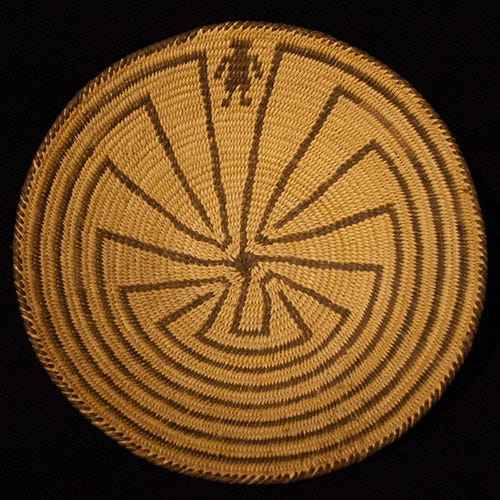
But here’s the profound part: the goal isn’t at the center. It’s in that final turn just before the middle, where you look back on everything you’ve traveled, seeing the pattern you couldn’t see while walking it. Kierkegaard captured this beautifully:
“Life can only be understood backwards; but it must be lived forwards.”
But what if that’s not just metaphor? What if your future self, having already walked the maze, is literally looking back at this moment right now, sending information backward through time? What if the pattern becomes visible not because you’re remembering the past, but because your future self is revealing it to your present self? Only then do you pass into the next world, transformed by the journey itself.
Contact experiences with UAPs work exactly like this. They force experiencers down paths that don’t make rational sense. They turn you around when you think you understand. And they reveal something terrifying: the maze knew you were coming because your future self is already at the center, looking back.
One Harvard psychiatrist spent the last decade of his career documenting exactly this pattern in hundreds of real cases—and what he found nearly cost him everything.
John Mack wasn’t someone you could easily dismiss. A Pulitzer Prize-winning Harvard psychiatrist, tenured professor at Harvard Medical School, and founder of the psychiatry department at Cambridge Hospital; He had spent decades building an impeccable reputation in mainstream academic medicine. So when he began seriously investigating reports of alien contact experiences in the early 1990s, it sent shockwaves through the academic establishment.
Mack didn’t start out believing in UFOs or alien encounters. He approached the phenomenon as a psychiatrist would: carefully, methodically, and with rigorous clinical standards. He conducted hundreds of hours of sessions with experiencers, expecting to find trauma, fantasy, or pathology. Instead, he found something that troubled him deeply: psychologically healthy individuals from diverse backgrounds reporting remarkably consistent experiences that didn’t fit any known psychological category. They weren’t psychotic. They weren’t seeking attention. They were genuinely traumatized by encounters they insisted were real.
What ultimately convinced him wasn’t any single case - it was the patterns. The phenomenological consistency across cultures, time periods, and demographics. The physical evidence that sometimes accompanied reports. The way experiencers’ memories behaved opposite to how false memories typically behave: crystallizing and becoming more detailed over time rather than fading and fragmenting. Most troubling of all: the experiences seemed to operate outside our fundamental categories of time, space, matter, and consciousness in ways that suggested we might be missing something crucial about the nature of reality itself.
His work cost him. Harvard launched an unprecedented investigation into his research (the first such inquiry in the school’s history), though they ultimately reaffirmed his academic freedom. Colleagues distanced themselves. His reputation took hits. But Mack continued documenting cases until his death in 2004, leaving behind a body of work that refuses easy dismissal: Abduction: Human Encounters with Aliens (1994) and Passport to the Cosmos (1999) remain two of the most rigorous explorations of contact experiences ever compiled.
When Catherine Met the Impossible
In March 1991, a 22-year-old music student named Catherine contacted John Mack about an experience that had occurred only weeks earlier. What she initially thought were childhood dreams turned out to be something far stranger.
Walking home from her job as a nightclub receptionist in Boston one February night, Catherine experienced missing time. Under hypnosis with Mack, she recalled being in a round room with curved, transparent walls ”like a big fish tank”. The room felt both physical and dreamlike simultaneously.
But the strangeness went deeper. What Catherine had dismissed as childhood dreams (a blue light in her room when she was three, a “funny-looking guy” peering through her window, being paralyzed at nine while “some kind of creature” reached for her with long fingers) these weren’t dreams at all. They were memories of encounters stretching back across her entire life.
During Christmas 1990, visiting her mother in Alaska, Catherine suddenly found herself in that curved-wall room again. The beings communicated without speaking, directly mind-to-mind. They knew things about her past she’d never told anyone. And they seemed confused by her questions about when things were happening, as if temporal sequence was a limitation she was imposing on an experience that existed outside linear time.
Most unsettling: Catherine’s perception of the beings shifted dramatically as she aged. As a child, she felt a naive trust. As a teenager, lying on a table in a dark room with beings scrutinizing her, she felt terror. She was experiencing the same phenomenon across different points in her timeline, but her consciousness could only process it sequentially, creating the illusion of separate “events” when it might be a single four-dimensional intersection.
Years later, working with Mack, more details emerged. Not as fading memories becoming corrupted, but as information crystallizing, becoming clearer and more vivid. As if the experience wasn’t in her past at all, but as if it was still happening, revealing itself in layers her three-dimensional consciousness could only access gradually.
Skeptics would say: false memory, sleep paralysis, trauma response. But this explanation requires ignoring the lifelong pattern, the impossible knowledge the beings possessed, and the phenomenological consistency across Mack’s hundreds of documented cases.
Catherine’s case is compelling on its own. But when we examine patterns across the experiencers Mack documented (hundreds of people from different backgrounds, cultures, and time periods), we see remarkable consistencies that demand a deeper framework for understanding what’s actually happening.
Where Our Categories Fail
There’s a reason contact experiences shatter people’s ontology. It’s not just what they see, it’s that what they do see shouldn’t be possible. The phenomenon operates outside our fundamental categories: space, time, matter, and consciousness. It appears simultaneously physical and psychic, technological and spiritual, external and internal. It violates causality, mocks our instruments, and leaves experiencers with memories that feel more real than consensus reality itself.
We’ve been trying to solve this puzzle with three-dimensional thinking. The nuts-and-bolts researchers search for crash debris and propulsion systems, and they find them. This keeps hope alive that we’re dealing with something comprehensible, just very advanced technology. The psychological explanation reduces contact to hallucination or trauma response, but can’t explain the physical evidence or the consistency across cultures and time periods. The sociological view sees cultural contagion and modern folklore, but then stumbles over pre-modern encounters and the phenomenological patterns that transcend cultural boundaries.
Each approach grasps a different facet, but something crucial is being missed.
In Edwin Abbott’s Flatland, two-dimensional beings can only perceive cross-sections of three-dimensional objects. When a sphere passes through their plane, they see a point appear from nowhere, expand into a circle, shrink, and vanish. To them, this violates causality. Things don’t just materialize and disappear. But the sphere never appeared or disappeared. It was always there, moving through a dimension Flatlanders are structurally incapable of perceiving.
The “impossible” behavior is just what three-dimensional physics looks like when you can only see two dimensions.
We might be in the same position.
The User Interface We Mistake for Reality
Donald Hoffman’s research on perception delivers an uncomfortable truth: evolution shaped our senses to maximize survival, not truth. Think about it: the organism that sees reality most accurately doesn’t necessarily survive better than the organism that sees reality most usefully. A deer doesn’t need to understand quantum mechanics, it needs to detect predators and find food.
What we perceive as “objective reality” (solid objects in three-dimensional space, time flowing in one direction) may be what Hoffman calls a “species-specific user interface”. Just as a computer desktop icon doesn’t resemble the electrical patterns it represents, physical objects may bear no resemblance to whatever actually exists beyond our perceptual bubble.
This isn’t just philosophical speculation. Hoffman and his collaborators have published peer-reviewed papers showing mathematically that organisms tuned for survival rather than truth will outcompete organisms tuned for truth. Natural selection has actively shaped us to not see reality as it is.
This matters for UAP phenomenology because it means the “high strangeness” features such as telepathy, precognition, reality distortion, and beings that pass through walls, aren’t bugs in our understanding. They’re features. They’re what happens when the interface glitches and experiencers catch glimpses of the operating system beneath.
Consider the classic patterns: craft that appear and disappear instantly. Time distortion where hours pass in minutes. The “Oz Factor” - that suspension of sound, slowed time, heightened clarity during encounters. Communication that happens without language, directly mind-to-mind. Objects that seem to know they’re being observed and respond accordingly.
Materialist frameworks call this impossible. But what if we’re the ones trapped in Plato’s cave, mistaking shadows on the wall for the only reality? What if the phenomenon operates in dimensions our perceptual interface actively filters out?
What if it’s calling us out of the cave?
You Are Bigger Than You Think
Here’s where we need to get weird - but stay with me, because this is where Catherine's experience and the broader patterns start to make sense.
Eric Wargo’s research on precognition suggests something radical: we are four-dimensional beings who’ve forgotten our temporal depth.
In his “Long Self” framework, Wargo argues the brain isn’t just processing present-moment sensory data. It’s a four-dimensional organ accessing information from both past and future. Imagine your entire life as a sculpture that exists all at once, from birth to death, with your waking consciousness as a moving spotlight that only illuminates the “now” moment. But your unconscious, your gut, your body, these are in contact with the whole sculpture.
Your future self isn’t separate from you. It’s literally you, just at a different temporal coordinate along your four-dimensional form.
The evidence comes from decades of precognition research. Dean Radin’s experiments in the 1990s showed participants’ physiological responses spiking before disturbing images appeared on screen. Not as a reaction to the images, but seconds before the computer randomly selected them. Their bodies were responding to future stimuli. This effect has been replicated nearly three dozen times across different labs. The statistical reliability is so strong that even the CIA took interest, declassifying their “presentiment” research in 1995.
Julia Mossbridge, a neuroscientist who has experienced precognition since age seven, is blunt about it:
“These aren’t hunches based on pattern recognition. They’re memories from the future”.
Some physicists hypothesize this works through quantum entanglement; Not just particles separated in space, but your brain entangled with itself across time. If your brain can be entangled with its future state, Radin explains, then
“in the present you’d be feeling something like a memory that is going to happen in the future”.
This isn’t fringe science anymore. It’s reproducible, peer-reviewed, and deeply unsettling.
Now, let’s return to the patterns Mack documented with this framework. Multiple experiencers reported dreaming about encounters before they happened. And they were detailed previews, not vague anxiety. From a Long Self perspective, the experiencer’s future self (who has already processed the encounter) sends information backward through time. It surfaces as symbolic dream imagery because four-dimensional information gets compressed when entering three-dimensional consciousness. When the actual encounter happens, their brain is partially remembering something it has already experienced from the future, creating that overwhelming sense of déjà vu.
Years later, as their future selves continue processing the encounters, more information flows backward. Memories don’t fade, they crystallize. Catherine experienced this directly. When working with Mack over time, more details emerged, clearer and more vivid. The experiencers are simultaneously remembering, experiencing, and pre-experiencing, all collapsed into a single event that only appears sequential from inside linear time.
The encounter isn’t a discrete moment in their past. It’s a four-dimensional intersection they’re still processing across their entire timeline.
Hyperobjects: Too Big to See All at Once
Now we need another framework to stack on top of this, because UAPs themselves might be operating the same way.
Philosopher James Madden applies Timothy Morton’s concept of “hyperobjects” to the UAP phenomenon in his book Unidentified Flying Hyperobject. Hyperobjects are entities so vast and distributed across time and space that we can only perceive their edges, never the whole thing.
Climate change is a hyperobject. You can’t point directly to it. You can only observe its effects: melting glaciers, shifting weather patterns, rising seas. It exists across temporal and spatial scales that exceed human perception. We experience it in pieces, but never the whole.
Madden’s insight is that UAPs function similarly. They’re not “craft from somewhere else” that occasionally enter our airspace. They’re hyperdimensional entities (possibly terrestrial, possibly not) that intersect with our three-dimensional reality in ways that appear as discrete “sightings”. But these sightings are like observing the shadow of a sphere as it passes through Flatland. The shadow changes shape, appears and disappears, seems to violate two-dimensional physics; Not because the sphere is breaking any laws, but because it exists in dimensions the observer can’t perceive.
Madden calls this the “Uber-Umwelt Terrestrial Hypothesis”. An umwelt is a biological term for the perceptual world of a particular organism. A tick’s umwelt contains only heat, smell, and touch. A human umwelt includes color, sound, and time. But Madden argues there’s an “uber-umwelt”, which are layers of reality beyond our perceptual bubble that we’re structurally blind to, the way Flatlanders can’t perceive depth.
The phenomenon isn’t hiding from us. We’re just looking at something four-dimensional with three-dimensional eyes.
Where the Frameworks Collide
Let’s bring this together by examining Catherine’s case and the broader patterns Mack documented through both lenses simultaneously:
The Lifelong Pattern: Catherine experienced encounters from age three through her twenties. Each encounter felt like a discrete event in linear time, but the beings themselves seemed confused by her temporal questions. From a Long Self perspective, Catherine’s four-dimensional consciousness was intersecting with the phenomenon at multiple points along her timeline. What appeared as separate encounters might be a single four-dimensional event that her three-dimensional awareness could only process in sequential slices.
The Crystallizing Memory: Over years of working with Mack, Catherine’s memories became more vivid and detailed (the opposite of how false memories typically behave). The encounters weren’t receding into the past; they were still happening from a four-dimensional perspective. As her future self continued processing the experiences, more information flowed backward, revealing layers her consciousness could only access gradually.
The Temporal Confusion: The beings appeared genuinely puzzled by Catherine’s questions about “when”. If they exist four-dimensionally across time (or more accurately, exist outside our three-dimensional temporal perception), then past, present, and future are simultaneously accessible. They weren’t being evasive. Her questions literally didn’t make sense from their perspective.
Now, when we look at patterns across Mack’s other documented cases, additional framework elements emerge:
Precognitive Dreams: Multiple experiencers reported dreaming about encounters before they happened. Not vague anxiety dreams, but detailed previews of events that would occur days or weeks later. From a Long Self perspective, the experiencer’s future self (who has already processed the encounter) sends information backward through time. It surfaces as symbolic dream imagery because four-dimensional data gets compressed when entering three-dimensional consciousness.
Impossible Knowledge: Experiencers consistently reported that beings knew details about their childhood, including forgotten memories and events they’d never told anyone. If the phenomenon interacts with the Long Self, the experiencer’s consciousness stretched across their entire timeline, then this omniscience makes sense. They’re engaging with past, present, and future versions simultaneously, not just the “now” slice the experiencer is currently experiencing.
Environmental Visions: Mack documented multiple cases where experiencers were shown images of environmental collapse that wouldn’t manifest for years or decades. Visions that later proved disturbingly accurate. If these beings exist outside linear time or access four-dimensional reality without our perceptual filters, they’re not predicting the future. They’re showing what already exists in the four-dimensional timeline.
Reality Distortion Effects: The “Oz Factor” (suspension of sound, slowed time, heightened clarity), objects appearing and disappearing, craft that violate physics - these aren’t malfunctions of perception. They’re what happens when the interface glitches and experiencers catch glimpses of the operating system beneath consensus reality.
Here’s the crucial synthesis: If UAPs are hyperobjects that exist across temporal dimensions, and humans are four-dimensional beings (the Long Self) who’ve forgotten their temporal depth, then contact experiences occur at the intersection of these two four-dimensional realities.
The encounter isn’t happening to Catherine (or any experiencer) in linear time. It’s happening through them across temporal dimensions they’re only beginning to perceive.
Why the Trickster Laughs
This explains why the phenomenon behaves like a trickster, appearing contradictory, paradoxical, and reality-bending.
It may not be deliberately deceptive. It’s interacting with multiple temporal versions of the experiencer simultaneously. Imagine trying to have a conversation with someone, but you can see and hear them at ages 7, 35, and 68 all at once, while they can only experience being 35. The conversation would appear bizarre from their perspective. You’d reference things they haven’t learned yet, respond to questions they haven’t asked, know details about their past they’ve forgotten.
That’s what contact looks like from inside linear time.
The beings in Catherine’s case seemed confused when she asked temporal questions: When did this happen? Will I remember this? From their perspective, or from the perspective of any consciousness that experiences time multidimensionally, these questions are malformed. It’s like asking “what does blue taste like?”. The question itself reveals a perceptual limitation.
Whitley Strieber documented this repeatedly in Communion. The visitors expressed genuine confusion about his insistence on temporal sequence. They seemed to find his questions about “when” almost quaint, as if he were asking for directions using only two dimensions in a three-dimensional world.
Jacques Vallée’s Passport to Magonia catalogs experiencers reporting beings who say things like “time is different for us” or express that human obsession with before-and-after is a perceptual limitation. The beings don’t answer temporal questions because the questions themselves don’t make sense to a four-dimensional intelligence.
The trickster quality isn’t a bug. It’s what four-dimensional interaction looks like when viewed through a three-dimensional interface.
The Wandjina: They Were Here Before We Forgot
But here’s what makes this truly unsettling: ancient traditions have been describing this exact framework for thousands of years. We’ve just spent centuries dismissing them as primitive mythology.
In the Kimberley region of northwestern Australia, Aboriginal rock art depicts the Wandjina; Supreme spirit beings and creators of land and people. These monumental, ghostlike figures have oversized eyes, no mouths, and halos or “helmets” radiating outward. The oldest paintings date back at least 4,000 years, but the oral tradition stretches far beyond that into the Dreaming.
The Dreaming (or Dreamtime) is not the past. It’s a dimension that transcends time and space entirely. A realm where ancestral spirits reside and from which all life originates. The Wandjina are “sky-beings” or “spirits from the clouds” who descended from the Milky Way during Dreamtime to shape the Earth and its inhabitants. They brought law, culture, and language. They taught humans how to live in harmony with nature.
And then, with their work complete, the Wandjina didn’t leave. They dissolved into the landscape. They laid down in rock shelters and became the paintings themselves; Their bodies becoming art, their spirits continuing in the land. Some returned to the sky and can be seen as lights moving above the earth at night.
Think about what this means: beings who exist simultaneously in the past (the Dreamtime), present (the paintings, the land itself), and future (generating new life). Beings who are both physical and non-physical. Beings who appear in forms, but whose true nature transcends form entirely. Beings who communicate through dreams, visions, and direct knowing.
The Wandjina, as described by Aboriginal mythology, are hyperobjects. They’re four-dimensional consciousness. They’re everything the phenomenon shows us, encoded in ancient wisdom we’ve spent centuries dismissing as folklore.
When Aboriginal people “refresh” the Wandjina paintings (carefully repainting them to keep them “alive”) they’re performing a ritual that bridges dimensions. The painting is a doorway. The paint is an offering. The act is communion with beings who exist outside spacetime, and who can be contacted because the distinction between “then” and “now” is itself a construct of three-dimensional perception.
The Wandjina tradition teaches something crucial: some intelligences don’t come from elsewhere. They’re already here, always have been, woven into the fabric of reality itself. They operate at frequencies our consensus worldview filters out. But indigenous peoples maintained protocols for perceiving them, for communicating with them, for understanding that reality has more dimensions than materialism acknowledges.
We had the map all along. We just convinced ourselves it was primitive superstition.
Consciousness All the Way Down
This raises an obvious question: How can any of this work? How can consciousness extend across time? What kind of universe allows retrocausation and hyperdimensional beings?
The answers might be simpler and stranger than we think: What if consciousness isn’t produced by brains at all? What if it’s fundamental to physics itself?
Bernardo Kastrup’s analytic idealism offers a framework that makes sense of all this. He proposes that phenomenal consciousness is the primary substrate of existence, with individual minds as dissociated segments of a universal consciousness. Think of it like Dissociative Identity Disorder (or more colloquially known as multiple personality disorder) writ cosmically large. Think multiple centers of subjectivity (you, me, everyone) emerging from a single consciousness through dissociative boundaries. We’re “alters” of universal consciousness. Individual neurons in a universe-spanning mind.
The inanimate world, in Kastrup’s model, is what consciousness looks like from outside its dissociative boundary. Matter is what mind looks like from the outside. A rock isn’t unconscious, it’s what mental activity looks like when you observe it from outside the dissociative boundary that creates the illusion of separation.
If this sounds too mystical, consider: it solves the “hard problem of consciousness” that has stumped materialist philosophy for centuries. How does subjective experience emerge from unconscious matter? It doesn’t. Consciousness is fundamental. Matter emerges from consciousness, not the reverse.
And if consciousness is fundamental and time is a dimension like space, there’s no reason consciousness should only move forward through time. The “arrow of time” might be a feature of our perceptual interface, not reality itself. Retrocausation isn’t impossible, it’s expected.
This would explain the precognitive dreams documented across Mack’s cases, the beings’ omniscience, the crystallizing memories, all of it. Information can flow backward through time because time isn’t what we think it is, and consciousness isn’t bound by the linear constraints we assume are absolute.
The Full Picture
Now we can see the complete framework:
Hyperobjects (Madden): UAPs exist across dimensions we can’t fully perceive. We experience their intersection with our three-dimensional reality as discrete “sightings,” but these are fragments of something vast and temporally distributed.
The Long Self (Wargo): Human consciousness extends across time from birth to death. We’re constantly in retrocausal communication with our past and future selves, though usually unconsciously.
Consciousness as Fundamental (Kastrup): Physical reality emerges from consciousness, not the reverse. Individual minds are dissociated segments of universal consciousness. The boundary between “self” and “other” is itself a construct. Time is navigable when you’re not confined to the three-dimensional interface.
Indigenous Wisdom (Wandjina/Dreamtime): Some beings exist outside linear time in dimensions accessible through ritual, dreaming, and properly attuned consciousness. The distinction between past/present/future is a limitation of consensus perception, not an absolute feature of reality.
The result: Contact experiences occur at the intersection of hyperobject reality and four-dimensional human consciousness.
This explains the phenomenology that makes no sense in materialist frameworks:
Why encounters feel both external and internal: They’re happening at the boundary where “self” meets “other,” but that boundary is itself a construct of dissociated consciousness. The experiencer is encountering something genuinely external, but the encounter is mediated through their own consciousness stretched across time. Catherine experienced this directly: beings who seemed both utterly alien and somehow intimately connected to her own past and future. The meeting happens in that liminal space where all dualities collapse.
Why the phenomenon appears to know impossibly personal information: It’s engaging with the Long Self; The experiencer’s past, present, and future simultaneously. Information from their future self (who has already processed the event) feeds backward through time.
Why memories surface and crystallize over time: The contact isn’t a discrete event in linear time. It’s a four-dimensional intersection that the experiencer processes across years, with their future understanding influencing their past memory. The event is literally still happening, temporally speaking.
Why screen memories and symbolic imagery appear: Four-dimensional information gets encoded symbolically when compressed into three-dimensional consciousness. The “grey alien” or “UFOs” might be how three-dimensional perception renders something that doesn’t actually have a stable three-dimensional form, much like the Wandjina’s radiating halo represents dimensional boundaries our ancestors couldn’t describe but could depict.
Why true disclosure may be impossible: You can’t reduce a hyperobject to a PowerPoint presentation. You can’t photograph four dimensions with a three-dimensional camera. The phenomenon withdraws from complete comprehension not because it’s hiding, but because it literally exceeds our perceptual and cognitive categories.
Walking the Maze
This brings us back to the maze. The Tohono O’odham symbol of I’itoi at the center of the labyrinth. The path that forces you through every turn, every loss, every choice that made you who you are.
The phenomenon may operate exactly like this. It forces experiencers down paths that don’t make rational sense. It turns you around when you think you understand where you’re going. It shows you that the journey itself is the transformation.
Contact is initiatory. Catherine's history of weirdness, encounters from age three forward, memories crystallizing over decades, beings confused by linear time, it all demonstrates this. It shatters the cave of perception and says: This is what you are. You are the Long Self, stretched across time...
You are both the Wandjina and the one painting the Wandjina. You are both the maze and the walker.
This is terrifying, but it should be. Every initiation involves a kind of death; The death of your previous understanding of what’s real, what’s possible, what you are. Mystery schools knew this. The Eleusinian Mysteries put initiates through darkness and terror before revealing the vision that transformed their understanding forever. Aboriginal cultures maintained protocols for Dreamtime journeys, with elders who could guide you through contact with beings outside linear time.
We don’t have these protocols anymore. Western modernity offered a trade: give up the mystical, accept the disenchanted mechanical universe, and in exchange you get technology, medicine, and material comfort. But the deal is breaking down. The phenomenon is one of many cracks showing the foundation was never as solid as we imagined.
Catherine's experience, and thousands like hers, force the question: What do we do now?
What This Means For You
If you’re still with me, you might be wondering: So what? What am I supposed to do with this information?
Here’s what I can offer:
If you’ve had an experience: Welcome! You’re not crazy. You haven’t hallucinated. Your brain isn’t broken. You’ve glimpsed through the interface to something stranger and more vast than our models accommodate. The paradoxes and impossibilities you experienced aren’t evidence that it wasn’t real; They’re evidence that it was more real than consensus reality, operating in dimensions your three-dimensional perceptual system struggles to render accurately.
If you haven’t had an experience: Pay attention to your precognitive moments. That gut feeling before the phone rings. The dream that comes true. The déjà vu that feels too specific to be coincidence. These aren’t flukes. They’re your Long Self communicating across time. Your four-dimensional consciousness breaking through the three-dimensional interface.
For everyone: We need new protocols. The indigenous peoples had them. Ways of navigating Dreamtime, communicating across temporal dimensions, living as four-dimensional beings rather than pretending we’re merely three-dimensional. We need to rebuild these practices for the modern world.
This might look like:
Taking precognitive dreams seriously, keeping a dream journal, noting which dreams have that particular quality of “future memory”
Paying attention to synchronicities not as random coincidences but as meaningful patterns in the fabric of four-dimensional reality
Practicing meditation or altered states that might allow access to different temporal layers of consciousness
Building communities where people can discuss high-strangeness experiences without pathologization
Developing frameworks that honor both the physical evidence and the consciousness-related aspects of the phenomenon
I don’t have a step-by-step manual. No one does. We’re rebuilding what was lost when we traded enchantment for materialism.
The Mystery Remains
This framework doesn’t “solve” the phenomenon, and it can’t. Hyperobjects by definition exceed complete comprehension. Four-dimensional beings trying to understand themselves through three-dimensional perception will always encounter paradox.
But what we can do is hold the mystery with more care. We can stop forcing it into categories that don’t fit. We can recognize contact as initiation rather than pathology. We can acknowledge that reality is stranger and more dimensional than our perceptual interface reveals.
The phenomenon teaches through breaking us. It’s a harsh pedagogy, but perhaps necessary. Perhaps we’ve become so trapped in our three-dimensional, materialist cave that only ontological crisis can lead us out into the sun. The phenomenon’s absurdity is pedagogical like a Zen koan that exhausts the rational mind until it surrenders and creates an opening.
The maze to metanoia isn’t a puzzle to be solved. It’s a transformation to be undergone. Not a destination, but the journey itself. And the phenomenon, in all its impossible, trickster, reality-breaking glory, might be exactly the guide we need, even if it’s not the guide we wanted.
Like I’itoi in the center of the labyrinth, the phenomenon reveals itself at the intersection of worlds. Not to give answers, but to force the deeper question: What are you, that you can experience something impossible and still be here to wonder about it?
Like the Wandjina who descended from the Milky Way and became the land itself, the phenomenon might not be visiting from elsewhere at all. It might be what’s always been here, what’s woven into the fabric of reality, what indigenous peoples maintained contact with while we forgot how to look.
Your gut knows before you know. Your future self sends messages backward through time. Your consciousness spans dimensions you’ve been trained not to perceive. The phenomenon cracks the interface so you can remember.
γνῶθι σεαυτόν. Know thyself. Not the three-dimensional self. The Self that exists across time, that participates in universal consciousness, that can perceive hyperobject reality when the interface cracks. The Self that is both the painting and the one being painted. The Self that walks the maze while simultaneously being the maze.
That’s the initiation. That’s what the phenomenon offers.
Whether we have the courage to accept it remains to be seen.
This article draws on the work of James Madden, Eric Wargo, Donald Hoffman, Bernardo Kastrup, Dean Radin, Julia Mossbridge, Jacques Vallée, John Mack, and the enduring wisdom of Aboriginal Dreamtime traditions. But the real research happens in the dialectic. What frameworks am I missing? What pieces of the puzzle have you found? What’s your experience been with precognition, synchronicity, or the phenomenon itself? Let’s build this map together in the comments.
Thank you for yet another amazing in-depth essay! Your thinking is 100% aligned with my own, which scares me. (HA HA!)
Some quick, random, disorderly, off-the-cuff thoughts...
* An interesting quote from Timothy Morton, who's a big influence on James Madden: "It is extremely healthy to know not only that there are monstrous beings, but that there are beings that are not purely thinkable, whose being is not directly correlated with whatever thinking is." (from "Hyperobjects: Philosophy and Ecology after the End of the World")
* Re. "remembering the future:" when I first saw the woman whom I would eventually marry, I blurted out "Oh good!" I **remembered her**! My immediate thought was "Great, she's finally here!" We've now been happily married for over forty years.
* By coincidence, I was just reading the book "The Art of the Wandjina" by I.M. Crawford. While visiting a site in the Australian outback in which there were rock paintings of Wandjinas, Crawford's Aboriginal guide decided to touch up and repair one of them, after which he proudly addressed the painting as if it were alive: "I made you very good now—I don't know how I did it. Very good!... You must be very glad, because I made your eyes like new. That eye, you know, like this my eye... I made them new for you people. My eye has life, and your eye has life too, because I made it new."
* During a "fungus-enabled" visit with the "teaching entities," I asked them about UFOs, and they suggested I study Tibetan Buddhist Cosmology. I was unfamiliar with the topic, and had no interest in it at the time, but as I learned about it I began to see their point: there are many realms and levels of beings. If a being wants to interact with one in a different realm, it has to manifest in such a way as to make itself perceptible. And so on...
Again, thanks! Please keep 'em coming!
I’m reminded of the story of the blind men and the elephant. This is usually treated as a parable of different teachers or religions having only fragments of a larger truth, but what if it’s about reality itself? The Wikipedia entry quotes Rumi as saying:
“The eye of the Sea is one thing and the foam another. Let the foam go, and gaze with the eye of the Sea. Day and night foam-flecks are flung from the sea: oh amazing! You behold the foam but not the Sea. We are like boats dashing together; our eyes are darkened, yet we are in clear water.”
https://en.wikipedia.org/wiki/Blind_men_and_an_elephant